Save 30% on ironing time: Unveiling the true efficiency of heat-reflective ironing board covers
Table of Contents
If you’re like me and view Sunday night’s “ironing time” as a chore you have to complete, you’ve probably tried all sorts of ways to speed things up:
- buying a more powerful steamer,
- turning up the TV to distract yourself, or
- even trying to teach your partner the skill (which usually ends in failure).
But you may be overlooking the most underestimated variable in the entire process—your ironing board.
Most people believe that ironing efficiency depends on how much steam your iron is blasting. This is a huge misconception.
As an industry observer who has tested hundreds of fabric and equipment combinations, I’m here to tell you a counterintuitive statistic: if you’re still using that ordinary cotton cover with cute little flowers, about 40% of the heat you generate every minute is probably absorbed and wasted by the foam pad underneath.
Today, we won’t talk about fancy storage features; we’ll talk about efficiency. We’ll delve into a game-changing technology—heat-reflective coating.
This isn’t just about making clothes smoother; it’s about how to “steal” back your time from tedious housework.
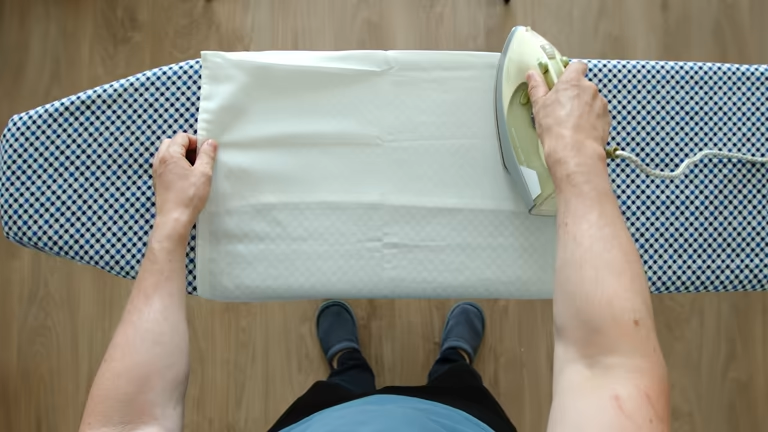
It’s not that your iron isn’t hot enough; it’s that your iron is absorbing heat.
First, we need to understand why the traditional ironing process is so slow.
When you lay a pure cotton shirt flat on a regular ironing board and press down a 200°C iron, heat conduction occurs. Heat is transferred from the iron’s soleplate to the fabric, which is fine.
But the question is, where does the heat go after it penetrates the fabric?
On the standard cotton or canvas cover, the heat continues to conduct downwards, absorbed by the synthetic foam pad and metal mesh underneath. Your ironing board gets scorching hot, but this heat does absolutely nothing to smooth out wrinkles in your clothes.
In other words, you’re paying to heat the air and the metal.
This is why many heat-reflective ironing board cover reviews mention a “turbocharged” feel. Heat-reflective fabrics typically use aluminum-infused or metallized surfaces.
This silver-gray surface isn’t just for looking like something from the space age; it functions similarly to the liner of a thermos or the foil in an oven.
When you iron, this metallic coating refuses to absorb heat; instead, it reflects the heat back into the clothing fibers, much like a mirror reflects light.
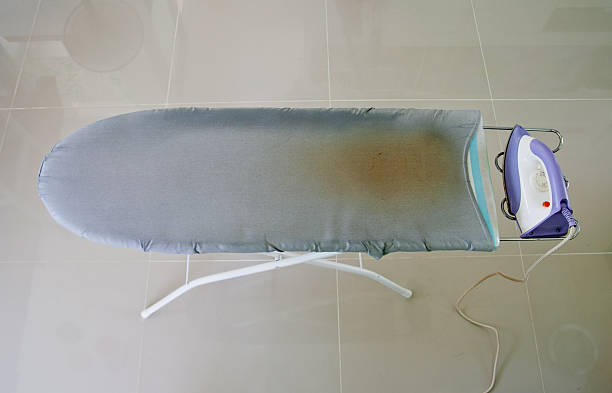
The principle of double-sided grilling: How physics speeds up your morning
Imagine you’re searing a steak. Is it faster to sear it on one side in a skillet or on a panini press? The answer is obvious.
The heat-reflective ironing board actually utilizes this physical effect of “double-sided heating.”
- Top heat source: Your steam iron provides direct pressure heat from above.
- Heat source below: The metallic coating reflects the heat that penetrates the fabric back, reheating the fabric from the bottom.
The direct result of this mechanism is that you no longer need to frequently turn your clothes over.
For regular T-shirts, jeans, or even thin casual shirts, ironing one side is often enough to make both sides smooth.
The “one-step ironing” technique you often hear about in fastest way to iron shirts tutorials is difficult to achieve on a regular iron, but it’s commonplace on a heat-reflective iron.
This isn’t just about skipping one movement; it’s about saving muscle fatigue and time over hundreds or thousands of repetitions.
Furthermore, this reflective mechanism can maintain a higher steam temperature. Ordinary breathable pads allow steam to cool and liquefy quickly (which leads to the condensation problem we discussed earlier), while the heat-reflective layer keeps the steam “dry,” allowing the high-temperature steam to stay between the fibers for a longer time, thus softening stubborn wrinkles more quickly.
A Feasible Calculation: The Hidden Losses of Time and Electricity
As savvy home managers, let’s do a math problem.
Regarding energy-saving ironing tips, many users often only focus on “when electricity is cheap” or “using residual heat to iron handkerchiefs,” but they overlook the huge leverage effect brought about by the efficiency of the equipment.
Assuming a typical family of four, they would need to iron approximately 20 items of clothing per week (including shirts, school uniforms, dress pants, etc.).
A 30% increase in efficiency is a very conservative estimate for heat reflection, as there’s no need for repeated flipping and ironing (many professional tests show increases of up to 40%).
| Method | Time per Item | Total Time / Week |
|---|---|---|
| Traditional method | 5 minutes | 100 minutes |
| Heat reflection enhanced efficiency | 3.5 minutes | 70 minutes |
What does that mean?
You save 30 minutes each week. That adds up to 26 hours a year. That’s an extra day you can use to read, spend time with family, or simply catch up on sleep.
-reflectiveLet’s look at energy costs. Steam irons are energy guzzlers in the home, typically consuming between 2000W and 2400W. Reducing usage time by 30% directly translates to a 30% reduction in high-energy-consuming electricity bills. While a high-quality heat reflective fabric might cost tens of dollars more than ordinary printed fabric, this investment can be recouped within three months through electricity savings. And that doesn’t even include the cost of your precious 26 hours of time.
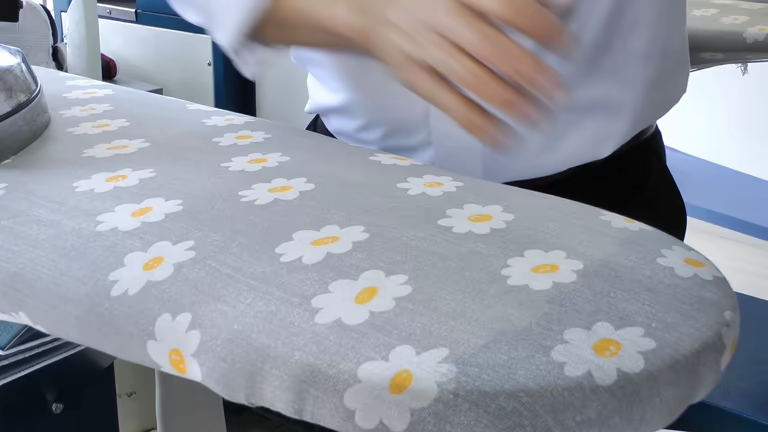
Change your “tactics”: adapt to gliding rather than heavy pressure.
,It’s worth noting that after upgrading to a heat-reflective ironing board , you’ll need to fine-tune your ironing feel.
Ordinary cotton fabric covers have relatively high friction, and you’re used to pushing and pressing them. But the surface of the metallized coating is very smooth, with extremely low friction.
This is actually an advantage, allowing you to use a more effortless “gliding” technique.
- Reduce downward pressure: There’s no need to press down hard, as heat utilization is increased. Simply use the iron’s own weight.
- Increase your movement speed: Because heat accumulates quickly, staying in one place for too long may cause the fabric to overheat (more details in the FAQ later).
- Steam burst: By utilizing the “sealing” effect of the reflective layer on the steam, you can use short bursts of steam instead of holding down the steam button, which saves water and is more efficient.
You’ll find that ironing is as smooth as gliding on an ice rink.
That’s why professional laundromats look so efficient—their equipment assists them, doesn’t hinder them.
In conclusion
In this efficiency-driven era, we’re willing to spend a lot of money on robot vacuums and dishwashers, just to free our hands from housework.
However, the ironing board in that corner is often forgotten, still stuck in the technological level of the last century.
Replacing that thin, yellowed ordinary cover with a cover featuring a professional heat-reflective coating might be your most cost-effective home investment this year.
It won’t change the fact that you still have to do housework, but it will allow you to finish the chores faster, gaining even a moment of freedom in return.
After all, no one regrets not spending enough time ironing clothes when they’re dying, right?
FAQ
1. Will heat-reflective fabric make clothes “sparkly”?
This is a common misconception. Shine on clothing is usually caused by excessive heat or pressure flattening the fibers, not by the fabric itself.
However, because heat-reflective ironing boards are extremely efficient, it is indeed recommended that you turn your iron’s temperature control down by half a setting.
If you’re looking for the fastest way to iron shirts without damaging the garment, it’s still advisable to use a pressing cloth for dark suits.
2. Will the metallized coating peel off over time?
Cheap products do have this problem; you’ll see silver powder stuck to your clothes.
When reviewing heat-reflective ironing board covers, look for products that specify “scorching resistant” and “integrated coating.”
High-quality covers have aluminum elements infused into the cotton fibers, rather than simply sprayed onto the surface; this process can withstand years of high-temperature friction without peeling off.
3. Besides speed, what other energy-saving ironing tips does this cover offer?
Yes. Because the heat-reflective layer is also an excellent waterproof layer, it prevents steam from penetrating into the felt pad underneath, thus greatly reducing the heat energy consumed to “dry the board.”
Almost all the heat generated by your iron is used to process the clothes, rather than to evaporate the moisture accumulated in the board pad, which is the ultimate energy utilization from a thermodynamic point of view.
Related Posts

Garment Steamer vs. Ironing Board: Want a shirt with sharp, defined edges?
-
Posted by
Webb Charlotte
Best pairing tips for ironing boards and steam irons
-
Posted by
Webb Charlotte