Precision ironing is no longer time-consuming: the efficient combination of ironing board and steam iron

Interestingly, most people believe that ironing depends solely on the performance of the steam iron. In reality, the key to efficiency often lies in that seemingly ordinary ironing board. It not only supports the garment but also influences steam diffusion, fabric stretch, and heat conduction. Only those who truly understand how to harness these two elements can complete a chore that once took half an hour in just 10 minutes.
From a time management perspective, ironing is essentially a competition between heat and surface. The key to optimizing this competition lies in the details that many people overlook.
The logic of steam: turning the ironing board into a thermal energy “accelerator”
The essence of efficient ironing lies in heat management. A steam iron releases high-temperature vapor to reshape fabrics, and the surface structure of the ironing board determines how quickly the steam can penetrate and recirculate. If the surface is too dense, the steam is blocked, and heat accumulates on the surface, which not only wastes time but also easily causes moisture to return to the garment.
A high-quality ironing board typically features a breathable metal mesh structure with a heat-resistant cotton cover, allowing steam to circulate in both directions—dissipating heat downward and rebounding upward. This “heat circulation system” can improve ironing efficiency by approximately 30%.
Furthermore, the stable support angle reduces repetitive strain on the wrist and shoulder. For those who frequently iron shirts or sheets, this difference can be noticeable over time.
If you spend an hour a week ironing clothes, you can save an average of 20 minutes by upgrading to a more breathable and stable ironing board, which equates to more than 17 hours of housework time saved over the year.
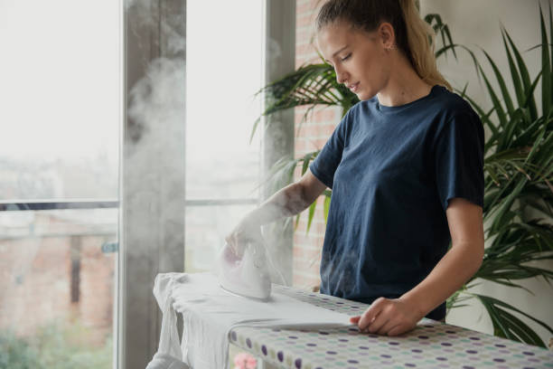
Matching rhythm: the “temperature control zone” of the steam iron and the “reaction surface” of the ironing board
A steam iron doesn’t produce a constant heat output; instead, it operates in cycles. When the iron is temporarily cooled or in standby mode, the thermal responsiveness of the ironing board determines the overall smoothness of the iron’s rhythm.
A high-quality ironing board temporarily stores heat, creating a “micro-heat zone” that helps maintain a stable temperature for the fabric. This means that heat isn’t lost immediately when you change clothes or adjust your position.
In practice, this detail can smooth out creases on cotton and linen clothing more quickly, without requiring repeated operations due to “heat breaks.”
If you’re using a high-pressure iron with a steam jet function, pay even more attention to the waterproof and breathable layer of the ironing board—it prevents condensation from accumulating under the cover cloth, avoiding damp odors or mildew.
The right board surface can extend the effectiveness of each steam jet, reduce repeated heating, and turn ironing from “repeated repairs” to “one-stop service.”
Space and Angle: How to synchronize the ironing board with the body
Besides heat, wasted time often stems from poor posture.
The ideal ironing board height should be slightly below waist level, 5–10 cm. This allows arms to remain naturally extended during extended periods of use, rather than raising elbows and causing fatigue.
Furthermore, modern designs increasingly feature boards with a “slightly curved” shape—a slight forward tilt that allows steam to naturally flow down the garment, preventing water accumulation and re-wetting.
Some brands even integrate anti-slip feet with a center-of-gravity locking system, which automatically stabilizes the iron when using steam mode to prevent it from moving and causing accidental burns. For families with children, this feature can be an invisible safety guarantee.
The optimized angle not only protects the waist, back, and wrists, but also reduces the distance between repeated placements of the iron. It has been measured that the action time can be reduced by about 15%.
Care and maintenance: synchronizing the life and efficiency of the ironing board
Maintaining high efficiency requires routine maintenance.
Steam ironing creates fine condensation. If the ironing board is left uncleaned or the cover cloth is left dry for extended periods, oxidation of the metal surface and yellowing of the cover cloth are likely to occur.
After each use, it is recommended to allow the iron and board to cool completely before removing the cover cloth and allowing the underlying surface to air out for 10–15 minutes. Wipe the surface with a neutral detergent every two weeks and keep it dry.
For frequent users, consider optional removable and washable covers and moisture-resistant underlays to reduce steam entrapment. Additionally, some newer panels feature aluminum alloy construction, which is naturally rust-resistant and suitable for high-humidity environments or enclosed storage spaces.
Systematic maintenance can keep the heat conduction performance of the ironing board stable, which not only reduces energy consumption but also ensures a smooth ironing experience.
Future trend: the emergence of intelligent ironing boards
With the expansion of smart home appliances, intelligent ironing boards have become a new trend in the industry. Some high-end models feature built-in temperature monitoring systems that automatically adjust the air vent according to the iron’s temperature. Some even incorporate timed reminders to ventilate and cool the iron after extended steam use to prevent overheating.
Under the trend of environmental protection, replaceable cover cloth materials are also shifting from ordinary cotton cloth to recycled fibers and fire-retardant coated cotton, extending the service life while reducing the environmental burden.
In the future, the ironing board will not only be an accessory but also an “efficiency partner” that can collaborate with the iron in real time, bringing home clothing care into a truly intelligent era.
Summarize
Ironing has never been a simple chore; it’s a science of time, heat, and detail.
When a steam iron and ironing board achieve the ideal balance, ironing is no longer a time-consuming labor but an efficient, rhythmic ritual.
—Make every ironing not only save time but also show quality.