Making ironing boards safer: Home safety tips for preventing scalding and slipping

In any household with children, an ironing board is more than just a household tool—it’s a device for managing potential risks. The metal surface, the heat of steam, the sliding brackets—these seemingly ordinary structures can all become safety hazards if children’s curiosity drives them. True family safety lies not in complete isolation, but in making tools more “controllable” through design and management.
Hidden risks in the home: potential safety blind spots of ironing boards
In most homes, parents tend to focus on safety in the kitchen, electrical outlets, and furniture corners but overlook the potential threats posed by ironing boards. According to data from the European Council for Consumer Safety (ECOS), approximately 4% of household burns each year are related to ironing, a significant portion of which stem from accidental contact by children.
The root of the problem lies in structure and habits.
- Height adjustable but not locked: Some ironing board brackets are loose and can easily tip over if touched by children.
- Residual high temperature: After the iron is turned off, the metal plate can still store heat for more than 10 minutes.
- Slip risk: If the floor is wet or the floor mats are old, the entire board may slip with a light touch.
These “invisible” details represent hidden risks that many parents overlook. The industry is addressing these issues through design optimizations, such as the use of non-slip bases, heat-insulating mesh surfaces, and automatic folding and locking systems, making ironing boards more child-friendly.
The scientific logic of anti-scalding: temperature control and structural insulation
The key to preventing burns lies not in the iron itself but in the heat conduction efficiency of the ironing board.
High-quality ironing boards typically feature a multi-layered construction: a breathable cotton layer on top, a heat-insulating foam layer in the middle, and a metal support layer at the bottom. This allows for rapid heat dissipation while preventing heat buildup within the board, which could lead to secondary burns.
Key points to avoid burns include:
- Breathable fabric design: high-density cotton or polyester blend to ensure heat dissipation outwards.
- Thermal insulation coating treatment: Some models use ceramic coating or silver ion thermal insulation film to effectively reduce surface temperature residue.
- Safety edge wrap: Avoid exposed metal edges from overheating after use.
For users, this is not just a safety indicator but also an upgraded user experience. The anti-scalding design allows for a more consistent ironing process at home, eliminating the need to wait for the iron to cool down and preventing the risk of high temperatures when children or pets are near.
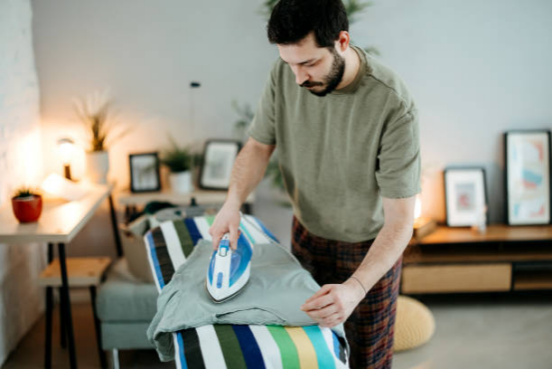
Anti-slip management: Combination of structural stability and family usage habits
Compared to scalding prevention, anti-slip issues are often more easily underestimated. An unstable ironing board may tip over due to a slight shake when a child approaches, causing secondary scalding or pinching injuries.
The key to anti-slip management lies in two aspects: structure and scene.
Anti-slip structure:
- Look for a style with rubber feet or a non-slip suction cup base.
- Check to see if the stand has a “stable locking structure,” such as an automatic snap-in slot or double-layer hinge.
- Pay attention to the base material: Plastic feet have limited durability and should be replaced regularly.
Usage scenario: Anti-slip
- Avoid using it directly on tiled or wooden floors; lay a non-slip mat.
- Do not iron clothes in areas where children play, especially if the floor is wet or uneven.
- Fold and store immediately after ironing to prevent children from climbing on or touching it.
Although these details are minor, they directly determine the safety factor of the ironing board. Many brands are launching “safety locking systems” and “anti-slip structural board feet” to provide more stable solutions for families.
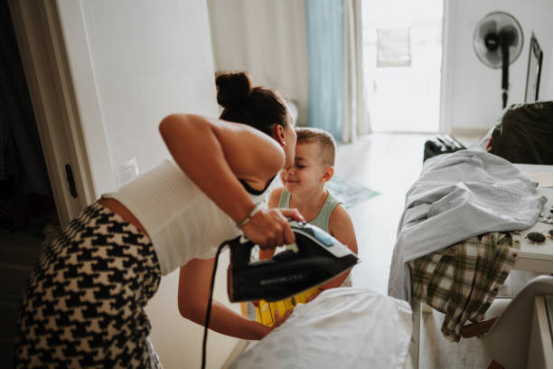
Child-friendly design trends: safety is more than just added value
Global home furnishing brands are incorporating child safety into their product designs. For example, in the European market, some ironing boards are certified to the EN 60335-2-3 safety standard and feature anti-scalding protection and automatic cooling systems. This trend is gradually expanding to the Asian market.
Current mainstream security innovations include:
- Anti-touch warning system: When the board temperature is too high, a color temperature warning will be displayed.
- Automatic locking mechanism: The stand automatically retracts when not in use to prevent accidental contact and falling.
- Lightweight and safe material: The aluminum-magnesium alloy frame replaces traditional iron, which is rust-proof and cools down quickly.
These changes reflect a broader trend: “Safety-aware design” is replacing a purely functional approach to home products. Brands are redefining ironing boards, moving beyond just ironing platforms to become “home system components” that address the safety of children, pets, and the entire family.
Maintenance and care: the final link to extend safety performance
Even the most advanced ironing board requires regular maintenance to maintain safety and performance.
The following are the key points of periodic inspection recommended by the industry:
- :Quarterly cleaning : Wipe the metal structure with a dry cloth to avoid moisture residue.
- :Replace the anti-slip mats every six months : aging of the material will significantly reduce the anti-slip performance.
- :Inspect the latches annually : a loose bracket may suddenly collapse under pressure.
- Avoid storage in high-temperature environments: Storing immediately when the residual heat from steam has not dissipated can easily cause oxidation of the frame.
Good maintenance not only extends the life of the product but also means more stable safety performance. For parents, this is a long-term risk management strategy rather than occasional safety awareness.
Safety details are the cornerstone of family happiness
Ironing board safety design is shifting from “passive protection” to “active prevention.”
When brands utilize scald-resistant materials, robust structures, and intelligent locking systems to ensure a safe home temperature for even an ordinary ironing board, this represents more than just product optimization; it represents a shift in lifestyle philosophy.
Perhaps, we can define true security as follows:
not eliminating risks, but making risks controllable.