Lighter is not always better when it comes to ironing boards.

In many families’ shopping lists, ironing boards are often relegated to a position that seems unimportant but is indispensable. The only time people truly start paying attention to them is when they find their existing ones inadequate. Consequently, the first keywords that pop up in search results are often “portable“ “” and “lightweight.”
Lighter weight seems to equate to greater convenience.
Greater convenience seems to equate to a better user experience.
However, this logic doesn’t always hold true in real-world ironing. In fact, an excessive pursuit of lightweight design is often the starting point for a decline in the user experience of many ironing boards.
This article does not discuss specific models or offer purchasing advice. Instead, it focuses on real-world usage scenarios, comparing the performance of lightweight design and sturdy structure in daily ironing to explain why “portability” can sometimes quietly sacrifice the experience.
Why has lightweight design become the top priority?
Before discussing the pros and cons, it must be acknowledged that
Lightness is a very attractive selling point.
From a user psychology perspective, the appeal of lightweight ironing boards mainly stems from three intuitive judgments:
- Easier to take out, less effort to store
- Low relocation cost, suitable for small spaces
- It looks more “modern” than traditional household tools.
Portable ironing boards are almost naturally advantageous, especially in apartments, shared housing, or homes with limited storage space.
Many users mention similar thoughts when sharing their user experience:
“I don’t iron clothes often, so I want it to be as light as possible and not take up much space.”
The problem is that this premise itself already contains hidden dangers for the user experience.
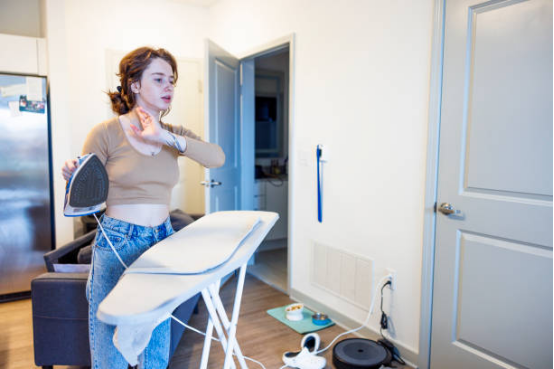
The first problem that is exposed during actual ironing is not weight.
Once the ironing board is actually unfolded, powered on, and put into use, the importance of weight will quickly be replaced by another set of metrics.
In real-world user feedback, the most frequent complaint wasn’t that it was “too heavy,” but rather:
- Board shaking
- Unstable support
- Displacement occurs when pressure is high
- The height changes during use
These problems are almost all directly related to “excessive lightweighting.”
Ironing is not a static action.
It requires:
- Push and pull back and forth
- Pressing down at different angles
- Continuous adjustment of body center of gravity
When the mass of the ironing board itself is insufficient to counteract these dynamic forces, lightness translates into instability.
This is why many discussions around lightweight ironing board pros and cons show a clear divide:
People think it’s great before they start using it but start to have doubts after using it for a while.
The impact of stability on the ironing experience is severely underestimated.
In user experience design, there is an often overlooked dimension called physical safety.
When a person stands in front of an ironing board, if they need to devote some attention to “preventing it from shaking,” the experience is already ruined.
Specific manifestations include:
- Smaller movements lead to decreased efficiency.
- I dare not use force; the wrinkles are difficult to deal with.
- Shoulder and back fatigue is more likely to occur after prolonged use.
Some studies on home ergonomics have pointed out that
An unstable operating platform can significantly increase the body’s micro-stress.
This tension is not obvious, but it can subconsciously make people shorten the usage time or even reduce the frequency of use.
This is why many families, despite owning an ironing board, use it less and less—not because they don’t need it, but because it’s uncomfortable.
The “Portability Illusion” of Portable Ironing Boards
The “portability” of portable ironing boards is often a mismatch between the intended use case and the actual application.
Its true strength lies in the following scenarios:
- Occasionally
- Temporary space
- Quick organization in a short time
However, in everyday home ironing, the scenario is often as follows:
- Continuous processing of multiple garments
- A larger pushing and pulling range is required.
- I hope to complete it in one go rather than repeatedly interrupting it.
When portability is used in high-frequency or medium-intensity scenarios, problems will gradually emerge.
Many users have mentioned a detail:
The lightweight ironing board is convenient to unfold, but it is actually more “laborious” to use.
This is a typical example of the “portability illusion”—the
The cost of moving is lower, but the cost of using it is amplified.
Weight is not a burden but a form of structural compensation.
In industrial design, weight is often not simply a disadvantage but a natural consequence of structural stability.
For ironing boards, the benefits of moderate weight are very specific:
- Better center of gravity
- Higher resistance to lateral forces
- More stable altitude maintenance
These characteristics directly affect ironing efficiency and physical strain.
In some user comparison experiences, the difference is clearly visible:
With the same iron and the same clothes, on a more stable board, the time to complete the task is shorter and the movements are more relaxed.
From this perspective, weight is not the opposite of the experience but rather part of it.

Why is the belief that “the lighter the better” so stubborn?
This idea is not accidental but rather the result of long-term reinforcement by multiple factors.
On the one hand, in the modern consumer discourse, “light” is often equated with “advanced” and “optimized.”
On the other hand, household tools are often marketed as something that “minimizes disruption to daily life.”
Thus, the ironing board was continuously pushed towards:
- Thinner
- Lighter
- It’s easier to store
But few people ask a crucial question:
Is it really effective during the 30 minutes it’s used?
When the “storage experience” outweighs the “user experience,” lightweight design can easily go to extremes.
The Hidden Relationship Between Frequency of Use and Sense of Structure
One noteworthy phenomenon is that
Stable ironing boards tend to be used more frequently.
The reason is not complicated—
When a tool makes people feel “reliable,” the brain is more willing to entrust tasks to it.
This has nothing to do with weight itself, but rather with the “sense of structure.” In actual design, however, the sense of structure is often manifested through a certain amount of weight.
This also explains a seemingly paradoxical phenomenon:
Some ironing boards that are not “portable” are actually more easily incorporated into daily routines.
How to reinterpret the experience between lightness and stability
This discussion is not to deny the value of lightweight ironing boards or portable ironing boards, but rather to re-examine their applicable boundaries.
The key is not whether it’s “light or heavy,” but rather
- Frequency of use
- Duration of a single use
- Intensity of ironing action
When these conditions change, what were originally advantages may turn into limitations.
This is why many users, after using it for a period of time, begin to re-evaluate their initial obsession with “lightness.”
FAQ (Frequently Asked Questions)
Q1: Are lightweight ironing boards always bad?
Not necessarily, but they are more likely to reveal stability issues during medium- to high-intensity daily ironing.
Q2: Who is a portable ironing board suitable for?
It is more suitable for low-frequency, short-term, and space-constrained usage scenarios.
Q3: Why does a sense of stability affect usage frequency?
Because instability increases physical tension, and people instinctively avoid this experience.
Q4: Is weight the only factor that determines stability?
No, but in most home environments, weight is one of the most intuitive and effective ways to compensate for structural defects.
Lightweight isn’t the goal; usability is.
When a tool is designed to “look convenient” but constantly consumes attention and energy during use, it has already deviated from its original purpose.
Perhaps the more worthwhile question to consider is not
“How light is it?”
Rather, it’s
about whether, when actually ironing clothes, it makes people feel at ease and convenient and willing to use it again.