What happens if you don’t have a dedicated organizing area at home?

The reason you can’t find a place for a piece of clothing is often not because your home is too small, but because there is no “place that belongs to it” in the space. The morning light has just fallen into the living room. The coat that was taken off last night is draped on the sofa armrest, the shirt that hasn’t been taken down yet hangs behind the dining chair, and the ironing board in the corner leans against the wall, half-hidden, like a tool that may be ignored again at any time.
This scene isn’t chaotic to the point of being overwhelming, but it always leaves one with a lingering sense of exhaustion. The problem isn’t the amount of stuff but the lack of a clear organizing area to handle the “second half” of these daily tasks.
How efficiency is gradually eroded when space is not divided.
Many home organization problems don’t erupt suddenly but are the result of long-term accumulation. Clothes don’t have a designated transit area after coming out of the washing machine; household tools can only be “put aside for now” after use; ironing boards that should be put away after ironing are left leaning against the nearest wall because they are inconvenient to fold and move.
While it may seem like you’re saving a few steps, you’re actually constantly creating new decision-making costs. Every “where to put it” decision is a small but significant expense. A frequently cited point in environmental psychology is that when a space lacks functional zoning, the brain is forced to repeatedly engage in low-value decisions, directly lowering overall efficiency.
Feedback from many families confirms this. Without a dedicated organizing area, tidying up is constantly postponed. It’s not that they don’t want to tidy up, but rather they think, “I’ll deal with it all at once when I have time.” The result is often piles of clothes, exposed tools, and a disrupted lifestyle, with no clear solution in sight.
This is a typical manifestation of the cluttered space impact: the more ambiguous the space, the more hesitant the action.
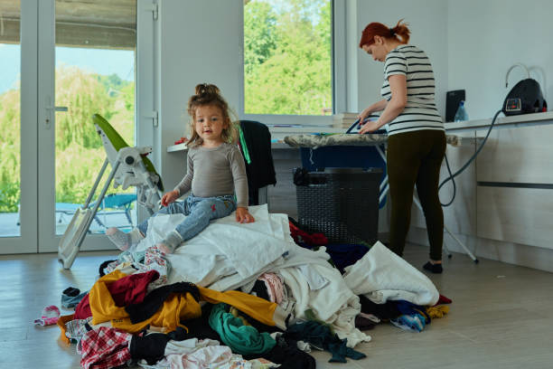
Household tools have no fixed location, and the emotional cost often outweighs the time cost.
On the surface, locating an ironing board should take only a few minutes. What truly drains people, however, is not the time itself but the uncertainty. Today the ironing board is in the storage room; tomorrow it’s moved to the balcony; the day after, it’s tucked into a bedroom corner.
This drifting state gradually turns the ironing board from a tool that serves daily life into one that occupies mental bandwidth. In user interviews, many people pointed out that the most resistant part is not the ironing itself but the preparation—finding the ironing board, clearing space, unfolding it, and then navigating the surrounding clutter. By the time the process begins, emotional energy has already been depleted.
The impact of cluttered space rarely appears as sharp anxiety. Instead, it manifests as a low-grade, persistent irritability. Over time, this makes people more likely to abandon chores they initially intended to complete and more prone to friction over minor issues. Gradually, tasks like ironing stop being manageable routines and become psychological burdens.
Why multifunctional spaces are the first to lose control
In homes without clear functional zoning, a common pattern emerges: every space is “almost usable,” but none are truly functional. The dining table doubles as both a place to eat and a surface for folding clothes; the sofa becomes a resting area and a temporary storage zone; ironing, tidying, and drying require constant movement between spaces.
This overlap is not a sign of laziness but of undefined roles within the home environment.
Residential studies suggest that spaces with clearly defined functions are more likely to remain orderly over time. The reason is straightforward: rules are embedded in the layout. An ironing area exists solely for ironing, supported by a dedicated ironing board; once the task is finished, the board is folded away and the space resets. By contrast, when an ironing board has no designated place and can appear “anywhere,” it inevitably becomes a magnet for clutter.
The real value of functional zoning is not about expanding space, but about reducing ambiguity. Ambiguity creates hesitation, and hesitation is where disorder takes root.

How a designated tidying area can change your mindset about housework
When a family designates a specific area for clothing care and household tools, the changes often appear sooner than expected. It’s not that there are suddenly fewer items, but that each task becomes shorter and more contained. Washing, drying, ironing, and storing all gain a clear destination, reducing hesitation between steps.
In this context, the ironing board is no longer an object that only comes to mind when wrinkles appear. A permanently placed ironing board becomes an active link in the workflow, with its physical presence quietly signaling what comes next in the process.
Many users have noted that once a dedicated tidying area is established, procrastination drops noticeably. The reason is simple: the initial effort required to start is lower. There is no need to rearrange furniture, clear temporary clutter, or search for tools. As the workflow smooths out, emotional resistance decreases, and overall mood becomes more stable.
This is why discussions around home organization are increasingly shifting away from storage techniques alone and toward spatial structure. The core function of a tidying area is not merely to store items, but to make previously implicit household chores explicit and actionable.
If you want to explore how this kind of “process visibility” influences daily decision-making, further reading on functional zoning in home spaces can offer a more systematic perspective.
Without a tidying area, family collaboration can quietly weaken
Another frequently overlooked consequence is the impact on collaboration. When clothes and tools lack fixed locations, housework tends to concentrate on a small number of people. The reason is straightforward: others are unsure where a task begins or ends.
After ironing, where should the clothes go? Should the ironing board remain set up or be put away? When these rules are unclear, potential helpers are more likely to step back rather than step in. Over time, responsibility defaults to the person most familiar with the process.
By contrast, a fixed organizing area anchored by a visible ironing board acts as a silent instruction manual. The steps are self-evident, and family members can join at any point in the workflow. This clarity often reshapes family collaboration more profoundly than it changes the physical space itself.
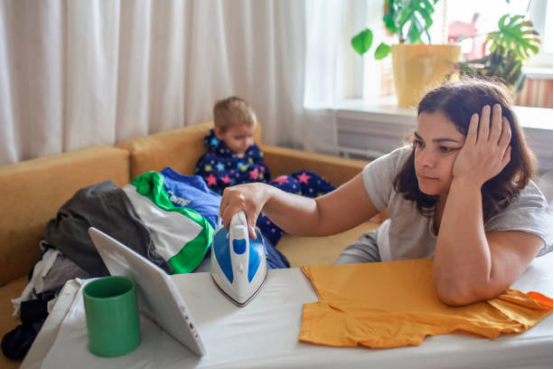
The purpose of organizing is not simply to keep things tidy but to prevent them from being repeatedly used.
Returning to the initial question: What happens if you don’t have a dedicated tidying area at home? The answer might not be dramatic. Things won’t immediately spiral out of control, nor will they become chaotic overnight. However, efficiency will gradually decline, your mood will be repeatedly worn down, and housework will become increasingly uninteresting.
The ironing board is just one concrete example. It exposes the chain reaction caused by the lack of functional boundaries in space.
Perhaps the real question isn’t “whether or not to tidy up,” but rather “is there a place where tidying up happens naturally?” When spaces begin to fulfill their specific functions, life often becomes much easier. Do you have such a tidying area in your home?