
In many households, housework isn’t actually “a lot,” but rather scattered. Things aren’t left undone but rather are constantly being remedied: done only when thought of, filled only when there’s no space, and placed wherever there’s room. This applies to clothing, cleaning, and especially ironing. The ironing board is often only brought out when “it’s simply unbearable to look at,” and then quickly disappears into a corner afterward.
The problem is never just laziness but a lack of processes.
When housework lacks a fixed order, it becomes reliant on emotions and memories. Once a routine begins to take shape, changes often come more drastically than anticipated.
Table of Contents
From “thinking before doing” to “completing in sequence”: the first watershed in household workflow
Household chores without a household workflow have one obvious characteristic: every step drains your willpower. Should I do it now? Where do I start? When do I consider it finished? These questions themselves slow down the process.
Take clothes as an example. Washed clothes, without a clear next destination, are often moved repeatedly: from the washing machine to the basket, from the basket to the chair, and from the chair back to the basket. Ironing is especially prone to being skipped because it’s not on the path that “must be done immediately.”
Once the process is streamlined, things change. Washing, drying, collecting, ironing, and putting away—each step has a sequence and a clear endpoint. The ironing board is no longer a temporary tool but a fixed node in the process.
Many users have reported that once the workflow is stable, housework becomes easier to start. This isn’t because they have more time, but because they no longer need to think about “what to do next.” The value of a household workflow lies in reducing this kind of low-level decision-making.
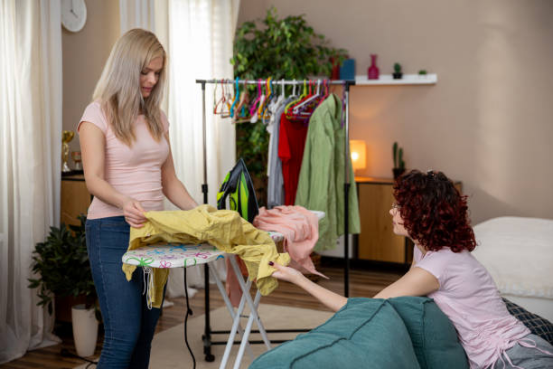
Why are stable tools a prerequisite for a process to function?
A process is not just a set of steps written on paper but a course of action that has been repeatedly tested and validated. If any part of it is unstable, the entire process will fall apart.
The role of the ironing board is often underestimated. When the board has to be moved, a location found, and the surrounding space cleared every time, ironing becomes difficult to integrate naturally into the daily routine. It gets constantly postponed and eventually becomes a backlog of tasks.
Conversely, ironing can only become part of the routine of building a home when the tools themselves are stable—fixed in position, at the right height, and requiring no extra preparation to unfold and store.
Behavioral research has concluded that people are more likely to stick to a “low-friction process.” This isn’t because the process itself is superior, but because the initial resistance is low enough. The stability of the ironing board directly determines whether ironing is included in the process or excluded.
How can standardized housework change how family members participate?
One direct result of systematic housework is that roles begin to be broken down. Without processes, housework often falls on the “most skilled person”; with processes, the ways of participation become more diverse.
Ironing is no longer a complete, closed process but has been broken down into several stages: preparation, operation, and tidying. Some people are responsible for laying out the clothes, some for operating the ironing board, and some for tidying up. Each person only needs to understand their own part.
Many families have found in practice that once the process is clear, reminders and nagging are significantly reduced. This is because the task no longer relies on someone’s memory but is driven by the process itself. The core of systematic housework is not efficiency but handoverability.
In this collaboration, the ironing board becomes a “common interface.” It makes actions visible and progress readily apparent.
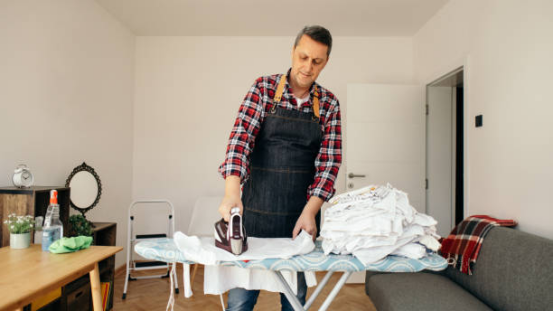
Mood changes are often more pronounced than efficiency changes.
When it comes to processes, many people’s first thought is efficiency. But in real life, what changes first is often emotion.
Household chores without a set routine are often accompanied by feelings of guilt and procrastination. Seeing piles of clothes makes one subconsciously avoid them; the thought of unironed shirts creates resistance. However, once a routine is established, these feelings are significantly reduced.
The reason is simple: things now have boundaries. Knowing when to start and when to end naturally reduces psychological burden. The ironing board no longer symbolizes “yet another unfinished task,” but rather a stop along the process.
This is why many discussions about routine building a home emphasize “a sense of accomplishment.” The process isn’t about making things perfect but about making it easier for people to stop.
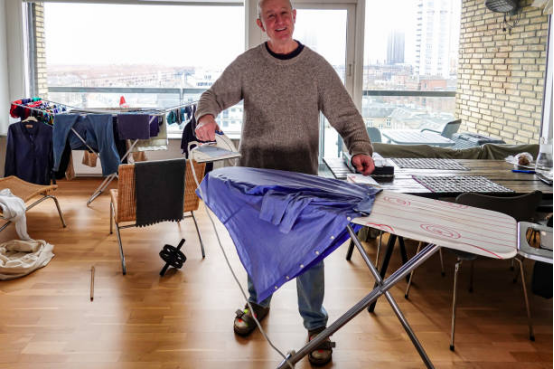
When housework is systematized, space and time begin to coordinate with each other.
Systematic housework often leads to a chain reaction: space begins to align with time. Ironing areas, organizing areas, and storage areas gradually become clearer, and the action paths are compressed.
The ironing board is no longer arbitrary but rather aligned with the rhythm of the entire household workflow. Questions such as when to use it, who will use it, and what the next step is afterward are no longer necessary to discuss.
Some users shared their experiences, noting that once the household chores routine became fixed, weekends actually became easier. It’s not that there were fewer chores, but rather that they were spread out throughout the day, no longer crammed into one period.
If you wish to gain a deeper understanding of this “process-space” relationship, you can read more about the design logic of systematic housework, which deconstructs how a family operates from a more macro perspective.
Once the process is established, housework will no longer require willpower.
Looking back, what truly tires people out of housework is never the actions themselves, but the cost of repeatedly starting new tasks. When every task requires “making a decision,” life naturally slows down.
When housework begins to follow a fixed routine, changes often happen quietly. The ironing board is still there, the clothes are still the same, but a sequence has emerged, the rhythm has stabilized, and emotions have softened accordingly.
Perhaps the question worth considering isn’t “whether to do housework better,” but rather “whether there’s a process that doesn’t depend on one’s mood.” When the process starts working, life actually becomes easier.