Ironing Board and the Formation of Clothing Aesthetic Standards

Have you ever stared at the crease on the back of the suit of the person in front of you on the subway during rush hour?
Those illogical wrinkles, as if pressed out while sleeping, were particularly glaring in the 8 a.m. sunlight. Most people ignored them, only caring whether the person was wearing the latest fashion. But for another small group, it was a visual disaster.
This “pickiness” is not innate.
It often stems from the moment you own a professional ironing board and start using it frequently. This may sound a bit exaggerated, but in my experience working for high-end menswear brands over the past decade, I’ve observed an interesting phenomenon: a person’s definition of “sophistication” often depends not on how expensive their clothes are, but on the time they spend taking care of them.
When we talk about ironing boards, we’re not talking about removing wrinkles, but about an extreme desire for control over lines. This desire for control will eventually become internalized as your aesthetic bottom line.

Crispness: The sensory threshold destroyed by “wrinkle-free technology”
The market is now flooded with “wrinkle-free shirts” and “wrinkle-resistant trousers.” As a marketer, I know exactly what’s going on. This is actually a compromise made by brands to reduce return rates (because wrinkles caused by shipping are the main reason for returns) by using chemical fabrics.
But if you get used to using an ironing board, you’ll find that the so-called “wrinkle-free” is a huge lie.
Wrinkle-free fabrics do indeed have no wrinkles, but they also lack “bones.” They hang on your body like a layer of dead skin. And when you lay a high-thread-count cotton shirt on the thick, breathable cotton padding of the ironing board, adjust the temperature, and press down firmly—note, “press down,” not just “slide”—you’ll feel a noticeable difference.
You’ll feel a physical resistance. The heavy metal iron, through the force of your arm, forcibly injects high-temperature steam into the fibers, and then, with the support of the ironing board, instantly reshapes the molecular structure of the fabric.
Once the shirt has cooled down, the crispness it exudes and the razor-sharp lines of the collar are something that no garment steamer or wrinkle-free technology can replicate.
Over time, your eyes become “spoiled” by these standards of clothing neatness. You start to be unable to tolerate floppy necklines or trouser creases that don’t hang straight down when you go out. Your aesthetic standards are artificially raised to a whole new level by this standard.
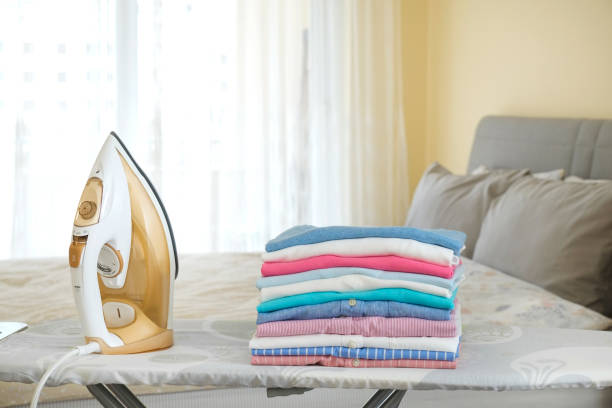
The “pressure” here determines your aura.
Many people confuse the difference between a garment steamer and an ironing board.
Garment steamers represent compromise; ironing boards represent reinvention.
A garment steamer relaxes fibers and eliminates wrinkles—it’s a form of “subtraction.” But ironing with a board is an “addition” process; you’re adding structure to the garment.
Imagine the curve of a suit sleeve cuff or the seam where a shirt sleeve meets the arm. If you simply apply a heat gun, the seam will still bulge. Only with the ironing board’s specially designed shoulder-shaped plate, combined with high-temperature pressing, can you flatten that seam as smooth as paper.
These meticulous ironing habits and aesthetics can even change your posture.
When you wear a finely ironed, perfectly pressed garment, you subconsciously straighten your back. It’s a wonderful psychological suggestion: clothes have edges, and people must also have spirit.
Industry insider secrets revealed: In top tailor shops on Savile Row, there’s an old saying: “Seven parts tailoring, three parts ironing.” A bespoke suit worth $5,000, if it hasn’t been shaped on a heavy-duty iron before leaving the factory, its visual value is less than $500. Those expensive, three-dimensional cuts rely entirely on ironing to give them their soul.
This infusion of spirit requires a stable surface. If you’re still using those shaky, cheap boards, you’ll never experience this sense of control.
Don’t let a wobbly board ruin your clothes worth thousands of dollars.
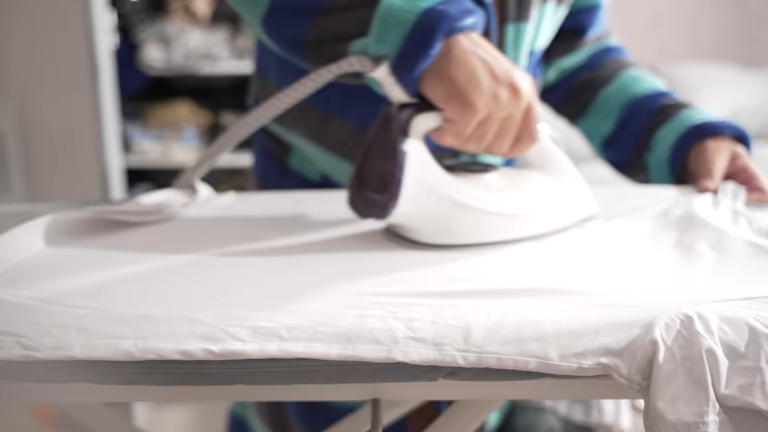
Visual authority: How do others judge you in 3 seconds?
In social psychology, there’s a concept called the “halo effect.” In the workplace or social settings, people’s perception of your dress is often formed within the first three seconds of meeting you.
A person who consistently uses an ironing board possesses an indescribable sense of “order.”
This sense of order comes not only from the neatness of the clothes but also from the lines that have been artificially crafted—the creases at the cuffs, the cinched waistline at the back, and the drape of the trouser hems—all of which subconsciously convey a signal to the other person: this person is self-disciplined, this person has high standards for details, and this person is in control of their life.
Conversely, those who wear expensive clothes but with blurred edges and casual lines are often labeled as “rough.”
But there’s a detail that most people overlook: this aesthetic is irreversible.
Once you get used to that extreme smoothness, you’ll develop a kind of “obsessive-compulsive disorder.” You’ll start to be picky about the thread count of the fabric (because low-thread-count fabrics can’t withstand ironing), and you’ll be picky about the cut (because a bad cut will never be smooth no matter how you iron it). This ironing board becomes a filter for your wardrobe, forcibly pulling you from the stage of “dressing haphazardly” to the stage of “appreciating fabrics and construction” experts.
This may sound like a burden, but in reality, it’s a huge aesthetic bonus.
FAQ (Frequently Asked Questions)
Q1: Since garment steamers are more convenient, why is a traditional ironing board still needed?
A: A garment steamer can only remove wrinkles, not “shape.” If you’re wearing silk or knitwear, a garment steamer is sufficient. But if you’re wearing a shirt, dress pants, or a structured jacket, only the solid surface and resilience provided by an ironing board can create sharp lines and smooth seams. This is the dividing line between “neat” and “refined.”
Q2: Will ironing for a long time damage the fabric of clothing?
A: This is a common misconception. Actually, proper ironing helps maintain your clothes. Through the breathable design of the ironing board and proper temperature control, steam can activate the elasticity of the fabric fibers. Conversely, if clothes are left unironed and twisted for extended periods, the fibers are more prone to breakage and aging. Of course, this assumes you don’t use 200-degree Celsius heat on synthetic fibers.
Q3: Why do I feel that ironing with an ironing board always doesn’t produce the same results as ironing at a dry cleaner?
A: The problem usually lies in two places: first, your ironing board is too thin, and heat and steam cannot penetrate, causing moisture to seep back in; second, your ironing board lacks sufficient “suction/blowing” function (unique to high-end boards). But for home use, the most crucial technique is “ironing”—not only should you spray steam, but you should also use dry heat to completely remove the moisture so that the clothes can retain their shape.
Q4: Does raising clothing neatness standards really affect workplace performance?
A: Absolutely. It’s part of nonverbal communication. Even if your colleagues can’t pinpoint the difference, the visual impact of the crisp will directly influence their perception of “professionalism.” The clearer the lines of your clothing, the stronger the boundaries of your professional image.
Conclusion
We live in an era that values “relaxation,” but I believe that true relaxation is built on a foundation of rigor.
Only when you have complete control over the folds of life can you talk about relaxation.
ironing board Standing in the corner of your home isn’t an instrument of punishment to make you do chores. It’s an altar. Every time you lay your clothes on it, listening to the hissing steam and watching the chaotic textures become orderly under your hands, you’re undergoing a miniature aesthetic baptism.
It teaches you not only how to dress neatly but also how to establish your own order and dignity through those straight lines in this world full of uncertainty and chaos.
So don’t rush to throw that old board away. Prop it up, and your life might become a little more upright. After all, in this appearance-obsessed world, your ironing board is your most discreet cosmetic surgeon.