The trend of synergistic upgrading of ironing boards and steam systems

The presentation doesn’t begin with a traditional family scene but rather with a more subtle feeling: the moment when fabric slowly unwrinkles in the steam, the instant it’s “reshaped,” increasingly feels like a ritualistic experience within home technology. It’s this hazy yet precise experience that has continuously redefined the relationship between ironing boards and steam systems, driving the development of so-called steam ironing board combos. More and more brands are exploring integrated architectures of steam stations, steam guns, and ironing boards, allowing users to achieve higher efficiency and more consistent ironing performance in smaller spaces.
Next, we will analyze the logic, technological direction, and deeper changes in user experience behind this “collaborative upgrade” from the perspective of industry trends.
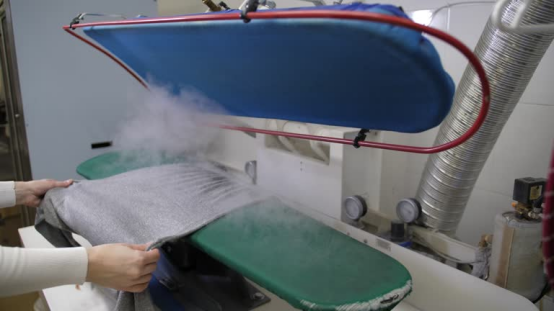
Vacuum coordination between the steam system and the ironing board
If we consider steam as an “active force,” then the ironing board is the “static structure” responsible for stabilization, support, and flow guidance. However, trends have shifted the relationship from a simple parallel one to a deeper, more interactive collaboration.
Traditional ironing tables only provided load-bearing and surface support; modern designs emphasize a three-in-one function of “suction, air blowing, and heat conduction.” Many steam station boards utilize multi-layered composite mesh surfaces, allowing for more controllable steam penetration, diffusion, and condensation. For example, some prototypes from European factories showcased negative pressure adsorption systems: when the steam gun emits high-speed steam, the work surface simultaneously draws in air, both locking in the fabric and accelerating moisture removal.
This kind of collaboration has several obvious advantages:
- Steam no longer scatters, making the ironing path straighter and the folds more stable;
- The integrated structure reduces heat loss, allowing the fabric to reach a malleable state in a shorter time;
- The countertop is no longer passively supported but has become part of the integrated steam ironing design.
This represents an evolution from “platform + tools” to “system-level integration,” which explains why Steam Ironing Board Combos are gaining increasing importance.
From Modular to Integrated: Structural Reorganization of Steam Stations and Ironing Boards
An interesting industry trend is that the more advanced the steam system, the more it tends to eliminate the traditional “external accessory model.”
Previously, steam stations had to be placed on a corner of a table or on a separate stand, with the piping running across the entire countertop; now, integrated steam ironing solutions integrate the steam boiler with the countertop as a “base logic.”
This design is not for aesthetic purposes but to address three long-standing pain points:
- The steam path is too long, causing pressure drop.
- External steam stations take up space and are inconvenient to move.
- The tubing is prone to tangling, affecting the fabric’s direction.
Placing the boiler on the lower layer of the ironing board not only shortens the steam path but also makes the pressure output more stable. Some professional-grade test data show that the integrated structure can reduce steam delay by about 18%-25% and also reduce the phenomenon of “sudden heating and cooling” of the nozzles on large areas of fabric.
More noteworthy is the impact on “platform structures.” To accommodate steam stations, some brands have begun using honeycomb panels to distribute weight evenly, ensuring the entire steam station board remains stable and doesn’t become unbalanced due to the equipment underneath. This also means that future ironing boards will no longer be single-layer panels but rather composite support structures similar to aerodynamics.
This futuristic design makes the all-in-one product increasingly resemble a home technology device rather than a traditional “household tool.”
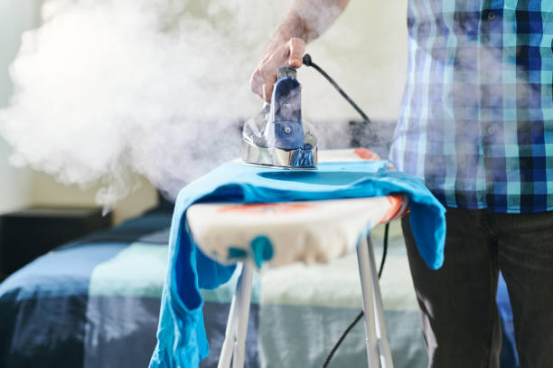
Steam guns serve as the core driving force: a trend towards lightweight, controllable, and precise interaction.
The steam gun has evolved from an accessory to a core driving element of the entire system, and its efficiency and performance directly determine the upper limit of the integrated steam ironing experience.
We can observe several obvious trends:
1. Steam guns are lighter.
To accommodate integrated ironing tables, the large metal boiler no longer needs to be housed inside the spray gun, reducing its weight by 20%-30%. Lightweight design means:
- Reduce wrist pressure
- Larger areas require more flexible ironing movements
- It allows for easier handling of skirts and wide-sleeved shirts in hanging mode.
2. More linear steam output
In the past, spray guns would experience pressure fluctuations when switching between “weak” and “strong” pressure. However, the new generation of spray guns uses a micro-orifice spray plate and a multi-stage pressure valve to make the steam “as even as a paintbrush.” Some users have shared their improved experience: when treating linen with linear steam, multiple passes are no longer needed. The fabric is gradually straightened in the atomized steam, as if it is being slowly reshaped.
3. Complementary to the movements of the ironing board.
A suction table and linear steam equal controllable fabric deformation.
The steam gun is responsible for the “movement,” and the table is responsible for the “stability.” The originally loose relationship between the two has finally been filled by technology so that ironing is no longer “one person doing two jobs.”
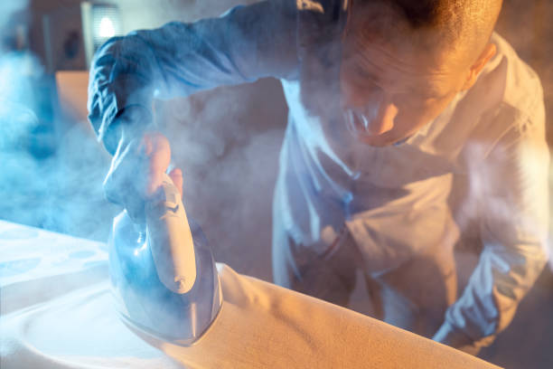
Spatial Trends: A Triple Transformation of Narrow Tabletops, Wide Shoulders, and Lightweight Structures
Regarding the future of ironing boards, the most discussed topic is not the patterns but the structure—a structure that is more in line with the rhythm of modern homes.
Trend 1: Narrow countertops are not a regression but rather an upgraded version of “zoning logic.”
A narrow countertop allows users to move around more easily and also reduces heat loss as steam diffuses laterally. Many steam ironing board combos feature a streamlined design that is narrow in the middle and wide at both ends, allowing for better positioning of shirt cuffs and trouser legs.
Trend 2: Widening of the shoulder area
Shirt fabrics account for a large portion of users’ daily ironing needs. The widened shoulders reduce wrinkles and folds when large areas of fabric are laid out. Combined with suction and direct current steam, a more uniform fabric finish is achieved.
Trend 3: Lighter, more stable, and less wobbly structures
Traditional heavy metal table legs are being replaced by aluminum-magnesium alloys and reinforced engineering plastics, resulting in reduced weight and increased torsional resistance, providing better support for integrated steam stations. Lightweight yet stable is a key selling point emphasized at major trade shows—this is closely related to changing user habits, as consumers increasingly prefer to iron in different rooms rather than in one fixed location.
Redefining the User Experience Layer: From Household Tools to “Device that Ensures Fabric Texture”
Although technological upgrades may seem to be creating “stronger steam and faster leveling,” the real trend is pushing ironing boards and steam systems toward becoming “fabricated equipment.”
In other words, the goal is no longer simply to smooth out wrinkles but to preserve the original texture and structure of the fabric.
For example:
- Wool fabrics require gentle steam and low suction power.
- Flax needs high-temperature steam but also requires rapid dehumidification.
- Polyester blends require temperature zone restrictions and segmented operations.
These demands have driven integrated steam ironing equipment to have more adjustable modes, allowing different fabrics to be “scientifically processed” on the same surface, rather than being pressed by pure physical force.
It’s no wonder that the industry has started to regard steam station boards as “fabric management equipment” rather than just ironing tools.
The future trend of collaborative upgrading and gentle reminders
As the steam system and ironing board become increasingly integrated, they are no longer combinations of independent functions but rather form a “miniature system” centered around steam, heat, and fabric behavior.
Whether you are more concerned with the accuracy of the steam gun, the suction logic of the worktable, or the overall efficiency of the steam ironing board combo, you will continue to see the results of these technological advancements in the coming years.
Delving into the ironing board and examining the structural evolution of different products and industry case studies may be more interesting than you imagine.
So, could the next home technology upgrade be this seemingly ordinary countertop in front of you?