Practical methods for testing the stability of an ironing board

In most households, the ironing board is often a highly functional tool, but one that is rarely examined carefully. It is quickly unfolded, its height adjusted, ironing completed, and then folded away again, a process that hardly prompts any thought. It is only when the board wobbles slightly while pressing down on clothes, or when one side noticeably sinks while adjusting the angle, that people realize stability is not a given but a structural performance that needs to be verified.
From a usage perspective, the ironing board plays a rather contradictory role. On the one hand, it must be lightweight enough to be easy to move and store; on the other hand, it needs to withstand continuous pressure from different directions within a limited contact area. It is this structural tension that makes its stability impossible to judge solely by appearance, weight, or price.
This article does not discuss “which one is better” or make specific product recommendations. Instead, it focuses on basic testing methods that users can perform themselves to help you determine whether the ironing board you have still has reliable structural support capabilities.
Why is stability often underestimated?
A recurring phenomenon in numerous user feedback and home furnishing discussion communities is that the instability of ironing boards is often not discovered at the beginning of use.
One reason is that the ironing action itself does not constitute a continuous extreme load. The pressure is intermittent and dispersed, which allows structural defects to be “averaged out” in early use. At the same time, people generally have low expectations for ironing boards, and slight wobbling is easily regarded as normal as long as it does not tilt significantly.
From a structural engineering perspective, the ironing board is actually a multi-node folding structure. Each unfolding, locking, and pressing action creates repeated stress on the joints, legs, and connectors. When the design or materials of these nodes have insufficient margins, a decrease in stability is almost inevitable.
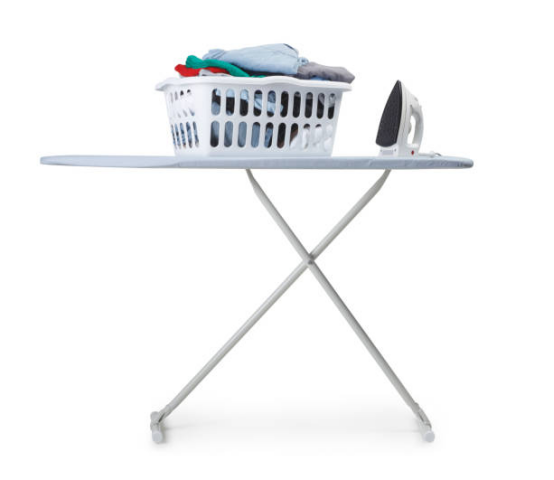
Single-sided load-bearing test: the most intuitive way to judge.
Of all the simple methods, the single-sided load test is considered the easiest to perform and the most valuable ironing board load test.
The procedure is simple. Fully unfold the ironing board and adjust it to your preferred height, ensuring all four support points are in natural contact with the ground. Then, slowly place a heavy object, such as a container full of water or a stack of heavy books, near one edge of the board.
The key point to observe is not whether it will tip over, but how the structure responds under load. A stable ironing board will typically exhibit slow overall stress and change, while a weaker board is prone to rapid tilting, leg displacement, or failure to quickly return to its original state after the removal of the load.
Many users realized for the first time through this method that seemingly normal ironing boards actually suffer from structural fatigue.
Structural response under lateral thrust
Ironing is not simply a process of applying downward pressure. When straightening sleeves, pulling trouser legs, or moving garments, the ironing board is constantly subjected to horizontal thrust, and this type of force often makes structural defects more easily exposed.
During testing, you can gently hold the board with both hands to simulate lateral movements in actual use, applying force slowly and controllably to the left and right. At this time, you don’t need to pursue the displacement range but should focus on whether the overall response is coordinated.
A well-structured ironing board typically exhibits a state of “synchronous movement as a whole,” while an unstable structure often shows a delayed response on one side, localized shaking, or even unusual noises. This inconsistent feedback is a very important signal for judging the stability of an ironing board.
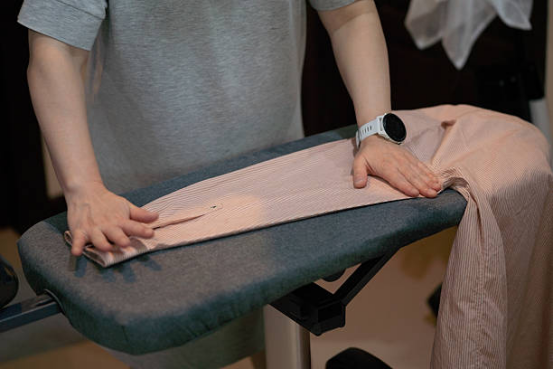
Height locking and node reliability checks
In many real-world cases, the stability issues of the ironing board do not stem from the outriggers themselves, but rather from the height adjustment and locking system.
You can adjust the ironing board to its highest height, then apply steady, continuous downward pressure to the center of the board and observe whether the height drops back, the latches slip, or there is a noticeable mechanical sound. Even a slight change indicates that the joint has begun to lose its original load-bearing capacity.
Some industry test reports indicate that even if the overall framework is designed reasonably, if the adjustment nodes are subjected to long-term pressure but lack sufficient reinforcement, the stability will gradually decrease with the frequency of use. This is why many users only feel that something is “wrong” after using it for a period of time.
Understanding the differences in stability from a structural perspective
From a broader perspective, the stability of the ironing board is mainly affected by three types of factors.
First, consider the outrigger deployment angle. A larger angle generally results in better lateral stability. Second, consider the number and distribution of connection points; multi-point connection structures are less prone to concentrated fatigue during long-term use. Finally, consider the clarity of the force path and whether the force can be effectively transmitted to the ground, rather than remaining stuck at a single joint.
Some independent home testing organizations have pointed out that even under the same material and weight conditions, the difference in stability brought about by different structural designs is still very obvious, which explains why ironing boards that look similar can have completely different user experiences.
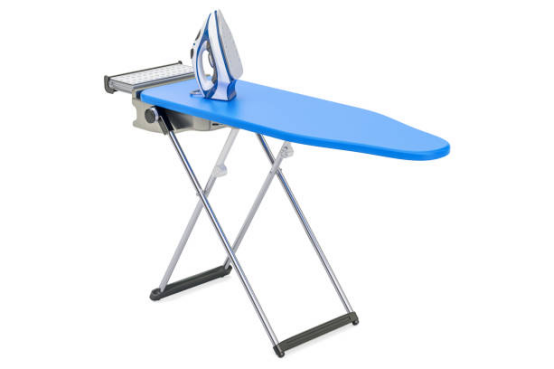
Stability changes over time
Performance will gradually weaken. It is important to emphasize that the stability of the ironing board is not a static property. With repeated folding and unfolding, as well as changes in ground conditions, wear on metal joints, loosening of fasteners, and aging of anti-slip components, the original structural performance.
Stability is not a subjective feeling
ironing boards Many people are used to evaluating ironing boards based on “how stable they feel,” but from a practical perspective, stability can be verified through observation and testing.
By using three methods—single-sided load-bearing, lateral thrust, and height locking checks—a relatively objective assessment of the ironing board’s structural condition can be made, even without specialized tools. This not only affects the user experience but also directly impacts safety and efficiency.
Pay close attention to its feedback next time you unfold it.
Perhaps the next time you unfold the ironing board, you can slow down a bit and observe its response to pressure and movement. Not to nitpick, but to confirm whether this frequently used yet rarely taken seriously tool is still trustworthy.
Have you ever encountered an ironing board that looks normal on the outside but reveals a problem at some point?
Or have you developed your own set of reliable habits for selecting or testing ironing boards?
Stability is never a label but a state that is constantly verified in daily use.