
In many families’ daily laundry routine, the ironing board is never a “discarded” tool, but rather something that has never truly entered the living system. It is not moved into the storage room, nor is it folded and leaned against the wall, and it rarely even appears on the household inventory list. After the clothes are washed, dried, and stored, they go directly into the next wearing cycle. Slight wrinkles are tolerated, and imperfections in the lines are accepted. Life still functions quite smoothly under this state.
tools butThis phenomenon is not accidental, nor should it be simply attributed to laziness or neglect of tidiness. On the contrary, families who have not used ironing boards for a long time often have a highly consistent and stable lifestyle structure that has been operating for many years. Understanding this is the only way to truly see that the no-ironing lifestyle is not based on the absence of tools, but on a change in an entire set of choice logic.
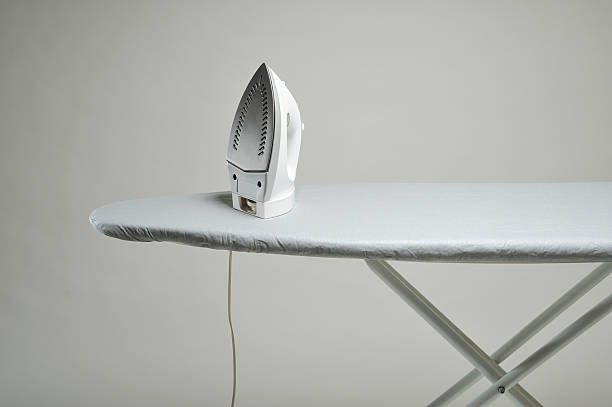
ironing boardThe choice of clothing sources often determines whether or not an Ironing Board is needed.
In these households, the wardrobe itself has already “preemptively eliminated” the need for ironing.
They don’t decide not to iron after washing the clothes, but rather they continuously filter out items that rely heavily on ironing to achieve their ideal state during the purchase and retention of clothing.
The first change is usually in long-term fabric preferences.
Knitted fabrics, blended fabrics, and materials with a certain degree of elasticity and resilience are being incorporated more frequently into everyday wear. These materials maintain a relatively stable shape even when naturally dried, without appearing messy or disorganized due to lack of ironing. Over time, this choice naturally evolves into stable wrinkle-free clothing habits, and the presence of the ironing board diminishes accordingly.
Secondly, there’s a reinterpretation of pattern and structure.
When clothing no longer emphasizes sharp creases, precise indentations, or highly symmetrical silhouettes, slight wrinkles are no longer seen as defects. Instead, they become natural marks left by clothing being worn, moved, and used in real life. In this context, the ironing board gradually shifts from a “necessary tool” to an “additional step to address style mismatches.”
-ironingFinally, there’s the strategic choice of color and visual complexity.
Darker, mixed-color, and textured fabrics naturally have the ability to minimize the appearance of wrinkles. This isn’t an aesthetic compromise but a practical solution proven by numerous families and a crucial prerequisite for maintaining a skip ironing lifestyle in the long term.
As the pace of life changes, the organization system must be restructured accordingly.
Families who don’t use ironing boards are often not actively pursuing “minimalism,” but rather making more rational choices about their life processes as time is constantly compressed.
In modern family structures, laundry is no longer a task that can be finely broken down.
It needs to be completed quickly, with a swift and closed loop, and it cannot create new bottlenecks in the day’s schedule. In contrast, the relatively uninterrupted time required for ironing seems particularly inappropriate.
The problem with ironing boards isn’t their efficiency, but rather how they consume your attention.
You can’t iron while waiting for a meeting to start, and it’s difficult to maintain continuous operation in a frequently interrupted home environment. This creates a structural conflict with today’s highly fragmented lifestyle.
ironing boardAs a result, many families did not explicitly “decide” to give up ironing but rather found that life could still run smoothly even if this step was eliminated, as they continuously streamlined their processes. When this situation persisted for weeks or even months, the Ironing Board naturally disappeared from the daily system and was no longer recalled.
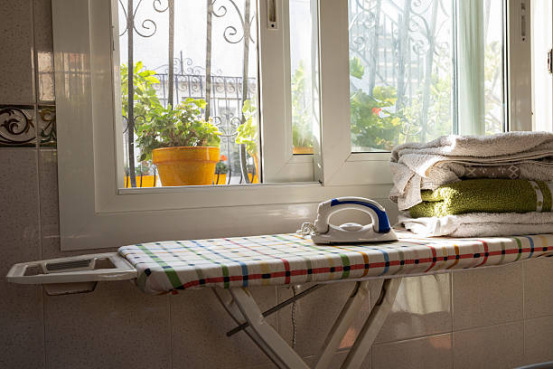
Not ironing doesn’t mean giving up on managing the condition of your clothes.
A common but inaccurate assumption is that families who don’t use ironing boards don’t take organizing their clothes seriously.
In reality, they’ve simply shifted their focus to other aspects of life that are easier to integrate into their daily routines.
For example, shape control is achieved during the drying stage.
The garments are moderately straightened while still damp, and their shape is set through gravity and natural drying. This method is repeatedly mentioned in numerous user experience sharing sessions and is considered the most cost-effective part of the skip ironing strategy.
For example, make systematic adjustments to storage methods.
Reduce complex folds and increase the proportion of hanging, allowing clothes to drape naturally during storage. Although this method requires some space, the trade-off is a stable state where wrinkles don’t need extra attention every morning.
Some families use a brief steam environment to alleviate localized wrinkles, such as the steam from a shower. This cannot completely replace traditional ironing, but it is sufficient for most everyday situations.
ironing boardWhen these methods are used in combination, the absence of an Ironing Board does not lead to chaos; instead, it creates a more cost-effective and less disruptive organization system.
Which families are more likely to leave the Ironing Board for an extended period?
ironing boardsFrom the perspective of user demographics, households that do not use Ironing Board are not randomly distributed.
First, there’s the group of people in a highly relaxed dress code environment.
Remote work, flexible dress codes, and the blurring of work-life boundaries mean that clothing no longer serves a strict “formal” presentation function. In this environment, the comfort and practicality of clothing are often prioritized over absolute smoothness.
Secondly, families with a clear understanding of the life cycle of clothing.
When clothes are viewed as temporary items rather than long-term assets, the priority of ironing, an activity used to prolong appearance, naturally decreases.
ironing boardAnother type of family is extremely sensitive to the burdens of life itself.
They systematically eliminate all “optional” steps, retaining only those activities whose elimination would significantly impact their quality of life. Under this screening mechanism, the Ironing Board is often among the first to be removed.
The absence of the ironing board is actually a result of a value ranking.
When a family doesn’t use an ironing board for an extended period, what truly changes is not their attitude towards the tool but rather a reordering of how they allocate their time, energy, and space.
Ironing hasn’t been negated; it’s simply shifted from a default behavior to an option invoked only in specific situations.
This change is itself a result of the continuous self-adjustment of modern life systems.
Not using it is not a form of confrontation.
Some families never use an ironing board, not because they deliberately oppose its existence,
but because in their life structure, the board has never been a key element in maintaining order.
When clothing choices, lifestyle, and organization methods are aligned, ironing naturally becomes unnecessary, leaving no mess.
This state may not suit everyone, but it truly exists and has been repeatedly proven by numerous families.
Perhaps the real question to consider is not whether or not you need an ironing board.
but whether your life system truly needs it to function smoothly.