The ironing board brings about an upgrade in the division of labor within the family

Before clothes are taken out of the washing machine, hung on the balcony to dry, and then put away in the closet, there is often one last step. Many families don’t ignore this step but rather tacitly leave it to “someone.” Over time, ironing becomes a default, assigned responsibility—concentrated, invisible, yet continuously consuming time and energy. In many households, this responsibility quietly revolves around the presence—or absence—of a functional ironing board.
But when the ironing process was restructured, and when the ironing board was no longer just a temporary tool but a “node” embedded in daily family life, things began to change. The focus of housework quietly shifted.
From fragmented labor to collaborative processes: The moment ironing was redefined
In many family surveys, researchers have discovered an interesting phenomenon: the division of labor is not determined by the chores themselves, but by the clarity of the process. Washing dishes, taking out the trash, and making beds are easily shared because the steps are clear, the time is short, and the standards are relatively uniform. Conversely, ironing has long been considered a task that “requires experience” and is “difficult to hand over.”
The problem isn’t with the clothes; it’s with the process.
When the ironing board is fixed in a stable position, the iron, spray bottle, hangers, and storage area form a continuous workflow. Ironing is no longer a spontaneous act but a predictable and modular process. The treatment of a shirt is broken down into laying it flat, heating, pressing, cooling, and hanging, with each step clearly visible.
The first change brought about by this standardization is the reduction of the psychological barrier. Family members no longer need to “know how to iron,” but only to “follow the steps.” In user interviews, many people mentioned that when ironing no longer depends on personal feel but on a stable ironing board and a fixed process, their willingness to participate increases significantly.
This is precisely the starting point for household task balancing: instead of distributing time equally, it’s about letting everyone know which segment they can take over.
Why housework always falls on one person: the overlooked structural reasons
When discussing shared home duties, common explanations include “who is more attentive” or “who is more skilled.” However, sociological research points out that a deeper reason lies in the irreplaceable nature of certain tasks. When housework lacks clear standards, it becomes difficult to hand over and is often carried long-term by the person “least likely to make mistakes.”
Ironing perfectly fits this characteristic.
Judging the temperature required for different fabrics, deciding whether fold lines are sufficiently flat, and determining the proper sequence are all forms of tacit knowledge. Without a clear framework, these judgments can feel intimidating to others. As a result, once one person assumes responsibility, it becomes hard to step away.
The introduction of an ironing board goes beyond simply providing a flat surface. A stable ironing board makes the entire action visible and assessable: height alignment, surface stability, and working space all provide immediate physical feedback. Errors are easier to identify, and successful results become more reproducible.
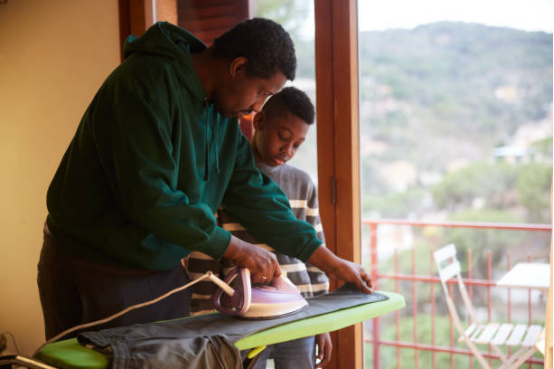
In some family cases, once the ironing board and surrounding area were reorganized, members who had never participated in ironing began to take on adjacent tasks—such as preparing garments, sorting items, or handling post-ironing storage. These seemingly peripheral steps quietly weakened the single-point dependency.
Shared home duties rarely begin with a full transfer of responsibility. More often, they expand through these small, insertable actions, gradually turning an individual task into a shared process.
When ironing becomes part of the family rhythm, rather than an extra burden
An interesting shift occurs in the time dimension. Traditional ironing is often squeezed into weekends or late at night, becoming a remedial act. But with a clear process, it’s easier to integrate into the daily rhythm.
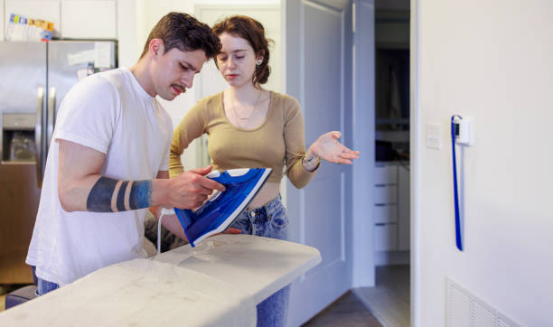
For example, some families schedule ironing during a ten-minute break after dinner, with two people working together: one operates the ironing board, while the other hands the clothes over and hangs them up. It’s quick, fast-paced, and leaves no room for delays.
This change may seem small, but it directly impacts family routine. Household chores are no longer interruptions to life but rather an integral part of life itself. Participants no longer approach it with a “helping out” mentality but rather with a “it’s my turn” attitude.
Many users have reported that conflicts actually decreased after ironing times were fixed. This is because the expectations were clear, responsibilities were defined, and it was immediately obvious who was doing what. This predictability is a severely underestimated factor in family collaboration.
Balance is not equal: Rethinking household task balance
When discussing household task balance, it’s easy to fall into the misconception that “everyone does the same amount.” In practice, however, a more effective balance often emerges from differentiated participation within families, rather than strict equality of time or effort.
The presence of an ironing board does not mean that everyone must become an ironing expert. Instead, a clearly positioned ironing board helps transform ironing from a closed, individual task into an open process. Some family members may be more comfortable operating the ironing board itself, while others contribute by organizing garments, managing time, or handling post-ironing storage. The roles differ, but they all exist within the same visible workflow.
Industry research indicates that when housework is modularized and anchored around stable tools like an ironing board, the number of participants tends to increase, while the burden on any single individual decreases. The decisive factor is not skill acquisition, but process transparency. Ironing’s evolution from an “individual skill” into a “family project” offers a clear illustration of this shift.
It is also worth noting that this structural change influences family communication patterns. Conversations gradually move away from “Can you do it?” toward “Who should take this step?” When the process is shared and the ironing board becomes a common reference point, this subtle shift in language often signals a loosening of rigid role expectations within the household.

The Underestimated Perception of Tools: How the Physical Environment Influences the Assignment of Responsibility
Few people would include an ironing board in discussions of family relationships, but environmental psychology has long pointed out that the visibility of tools influences the attribution of responsibility. When the tools for a task are hidden away in a corner, they are more easily overlooked; when they are in a public space, they become a collective matter.
Some families choose to set up their ironing area in a semi-open space, rather than a completely secluded balcony or storage room. As a result, the ironing process is more easily “seen” and more readily passed on naturally.
This isn’t about creating oversight but about creating opportunities for participation. Sharing household chores often begins with convenience. When the ironing board no longer needs to be deliberately moved out, it lowers the cost of convenient participation.
If you are interested in this deconstruction of spatial and collaborative relationships, you can read more about the visualization design of family tasks, which supplements the practical path of shared home duties from another perspective.
When a board changes more than just the folds of clothing…
Returning to the original question: Why does ironing always fall to the same person? The answer might not be complicated. It’s not because others are unwilling, but because the process doesn’t welcome them.
An ironing board goes far beyond simply supporting clothing. It makes actions visible, standards replicable, and participation legitimate. When the process is opened up, family members have the opportunity to re-engage in this long-closed household chore.
Perhaps next time, when the iron heats up and the clothes are laid out, you’ll find that the person standing on the other side of the board is no longer the same person. Upgrades in the division of labor within the family often happen in these seemingly insignificant moments.