The difference between a garment that is frequently ironed and one that is never handled.

Some families always seem very relaxed. There are no clothes piled up on the sofa, the chair backs are empty, and there are no coats “temporarily hung” by the door. They don’t have a lot of clothes, but they always look neat, clean, and orderly. This state is often misunderstood as “diligence” or “being tidy,” but if you observe carefully, you will find that the difference is not in how much physical effort is put in, but in the way tools, space, and the rhythm of behavior are coordinated. One often overlooked but recurring detail is the ironing board.
Table of Contents
A seemingly relaxed family isn’t always tidying up.
In interviews and lifestyle studies on organized household habits, a counterintuitive conclusion has been repeatedly mentioned:
The more relaxed a household appears, the less likely it is to engage in “centralized tidying up.”
Families whose clothes are frequently ironed rarely consider grooming a task that requires dedicated time.
Conversely, families that never organize are more prone to cyclical exhaustion—weekends piled high with laundry, emotions suppressed, and ultimately, giving up.
The root of the difference lies not in attitude, but in whether there is a low-resistance consolidation point.
And the ironing board is precisely that point.
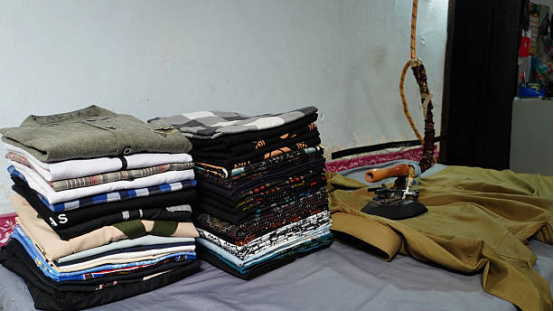
The frequency of ironing determines the “status” of clothes in the home.
A garment’s place in the household system changes if it is frequently ironed.
It won’t be tossed onto a chair or relegated to a corner. Because it “deserves to be kept.”
Conversely, clothes that are never tidied up will gradually be categorized as “non-priority items.”
Even if they are of good quality, they will be excluded from daily selection due to wrinkles and sagging.
In the breakdown of effortless home look, many cases show that
The state of clothing directly affects whether the living space appears quiet and orderly.
The stability of the clothing largely depends on whether the ironing board can be used conveniently, rather than being “sacrificed.”
The rhythm of behavior is guided wherever the tool is placed.
Observing families who iron frequently reveals a common thread:
The ironing board is not a tool for temporary use but rather an integral part of their daily space planning.
It might be near the laundry area, on the side of the walk-in closet, or it might be quick to unfold and quick to fold.
The key isn’t the form, but rather that
Using it requires no extra mental preparation.
When the ironing board is readily available, ironing naturally becomes part of the daily routine.
When it means “making room,” “finding a spot,” or “cleaning up the mess,” ironing is postponed indefinitely.
The position of tools is often more powerful than a person’s self-discipline.
Never tidying up is actually a passive choice.
Many people don’t resist tidying up; rather, they’re worn down by the complex process.
In user feedback regarding calming their home environment, similar statements frequently appear:
“It’s not that I don’t want to; it’s just that I don’t have the energy right now.”
When the cost of using an ironing board becomes too high, cleaning will be flagged as “high-energy-consuming behavior.”
Over time, abandoning it becomes the default option.
This is not a personality issue but a system design issue.
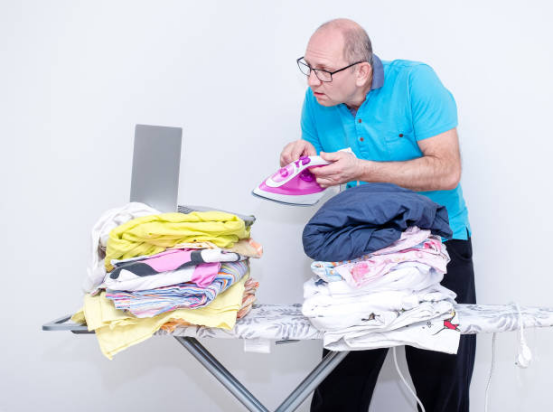
Clothes that are frequently ironed change more than just their appearance.
Ironing may seem to only change the wrinkles, but its chain reaction goes far beyond the surface.
Once clothes are kept flat, they will be used more often.
with increased use, clothes are easier to wash and put away promptly; and
With smooth putting away, the space will feel quieter.
This is the underlying logic behind many families’ effortless home look:
not that every step is perfect, but that every step is effortless.
The ironing board appears repeatedly in this process, like an overlooked metronome.
Rhythm is more important than diligence
Comparing the two family situations reveals that the real dividing line is not “whether to do it or not,” but “how quickly to complete it.”
- Can ironing be completed in a few minutes?
- Is the ironing board readily available?
- Can the clothes quickly return to a wearable state?
When the answer to these questions is yes, organization will not be delayed.
When the answer is no, chaos will be rationalized.
This is also one of the most decisive factors in organized household habits.
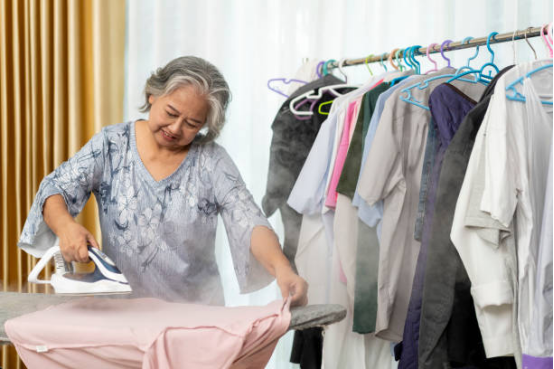
How a small change can disrupt the overall order
Numerous case studies demonstrate that when a particular tidying element in a household is optimized, other behaviors automatically follow suit.
Increased use of ironing boards significantly reduces clothing accumulation;
reduced clothing leads to less visual noise;
and a quieter environment makes people more willing to maintain order.
This is a typical “low input, high feedback” structure.
If you wish to gain a deeper understanding of how clothing care affects the rhythm of family life, you can read further analysis on the relationship between clothing care and space efficiency to re-examine daily organization from a systemic perspective.
The difference has never been about being diligent or not.
The difference between a garment that is frequently ironed and one that is never tidied up is superficially just wrinkles, but in reality, it’s about order.
And behind that order lies the convenience of the tools, the support of the space, and the kindness shown to the wearer.
Perhaps, the next time you see a home that looks relaxed, instead of envying it, take a closer look:
Has the ironing board become an integral part of their lifestyle?
When tidying up is no longer something that requires courage, the home will naturally become quiet.