Custom-designed ironing board suitable for professional tailors

Some tailoring studios always appear impeccably organized, with fabric laid out like flowing water and stitches so clean they’re almost flawless. People often focus only on the sewing machines, overlooking another tool that quietly shines in the corner—the ironing board, constantly heated yet always perfectly flat .
In the professional tailoring world, everyone knows that a regular household ironing board simply cannot withstand the heavy steam, prolonged pressing, and shaping of thick fabrics. Therefore, custom-made ironing boards specifically designed for tailors have gradually become a necessity, much like a pair of handy scissors, crucial to a smooth workflow.
This article delves into the real professional needs, breaking down the structures, materials, angles, and details that allow an ironing board to become a tailor’s “invisible trump card.”
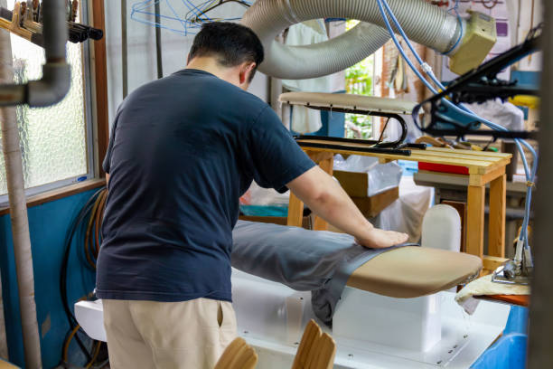
Why do professional tailors insist on using custom-made ironing boards?
In the fabric processing stage, the level of attention to detail often determines the quality of the final garment. Once the fabric is pressed into incorrect textures on a poor pattern or scalded yellow by steam, even the most skilled sewing techniques cannot repair it.
Professional tailors don’t just need something “usable,” but rather something “stable,” “controllable,” and “accurate.” This explains why many experienced tailors have almost demanding requirements for tailor ironing boards :
The pattern board must be large enough, but it’s not just about being “large.”
The fabric must be completely flat when laid on the board, especially for expensive fabrics like wool, silk satin, and tweed, where even the slightest wrinkle can affect the direction of subsequent stitching. Experienced tailors often have specific requirements for the width and shape of the pattern board to avoid “hanging points” in the fabric when turning corners.
The heat-resistant fabric layer is not just for decoration, but a protective shield.
High-temperature steam encountering a poor-quality fabric layer can leave a slight yellowing mark in just a few seconds. Professional panels employ a multi-layered heat-resistant structure, capable of withstanding prolonged steam impact while maintaining the original texture of the fabric.
Angle adjustment is the efficiency switch.
Different garment structures require different pressing angles; for example, sleeve caps need to be three-dimensional, waistlines need to be smooth, and collars need to fit snugly. A true custom sewing board allows tailors to quickly fine-tune the angle, making each pressing action closer to “sculpting.”
Some tailors will adjust the board higher, allowing the fabric to naturally straighten under gravity; others will adjust the angle lower, allowing for more precise alignment of layered fabrics.
These requirements may sound a bit like tuning an instrument, but for a tailor, ironing is an “art of touch and intuition.”
The significance of a larger panel: It’s not just about space, but about a greater control over the fabric.
You may have heard many tailors complain that “the pattern is too narrow, causing the fabric to sag at the edges,” and this is by no means dramatic.
When fabric sags due to unstable support, even by only a centimeter or two, it will change its direction of stretching, ultimately causing the cut piece to deviate in shape.
Large-format custom-made ironing boards typically offer the following advantages:
1. Large-area support reduces torsion.
Especially for long skirts, trench coats, and suit jackets, the large-area spread allows the fabric to maintain its natural state during ironing.
This reduces human pulling and makes the ironing process smoother.
2. Suitable for prototyping and finalizing complex structures.
In draping, for example, the fabric needs to be repeatedly adjusted, folded, and gently pressed on a pattern. Narrow patterns are simply not enough, and many tailors even design their own width and front shape to fit common garment structures.
3. Enables more precise heat pressing of details.
For example:
- overcoat placket
- skirt hem arc
- Cuff folding and stitching
These areas are often “not enough space to expand” on a regular home board, but on a professional board it’s like performing on a wide stage, allowing for much more freedom of movement.
Online professional garment-making courses also generally emphasize that “a large pattern and a stable frame are prerequisites for high-quality ironing,” and even list it as one of the core conditions for improving the quality of finished garments.
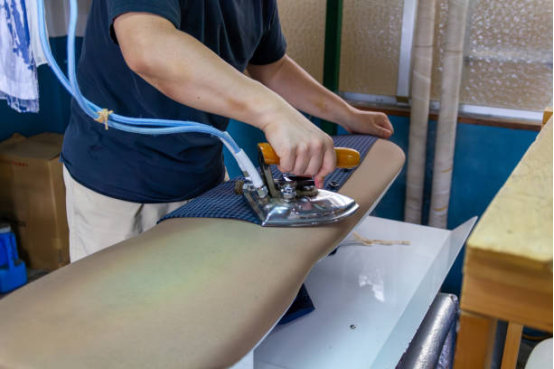
Differences in the layers of heat-resistant fabric: Why professional iRoning board is more durable
If the main stage is the slab, then the fabric is the ground beneath the actors’ feet—it must be safe and controllable.
There are several key aspects of fabric layers used by professional tailors that are often overlooked:
1. High heat-resistant materials prevent secondary damage to the fabric.
Ironing temperatures under steam can exceed 180°C, especially when handling wool and cotton/linen fabrics which require even higher temperatures. If the fabric layer’s heat resistance is insufficient, the following may occur:
- Microfocal
- Steam yellowing
- Fabric adhesion
These all directly destroyed the fabric.
2. The multi-layered structure allows for more uniform pressure distribution.
A high-quality custom sewing board is not made of just one layer of cotton cloth, but rather:
- Outer heat-resistant fabric
- Middle layer high elasticity buffer layer
- bottom stable barrier layer
This structure allows the force applied by the iron to be distributed evenly, greatly reducing the possibility of localized “crushing” of the garment, which is especially necessary for sensitive fabrics such as silk.
3. Not prone to collapse with long-term use.
Some users have reported that regular ironing boards tend to sag noticeably after three months of continuous high-temperature use, resulting in unevenness in the center area.
In contrast, professional boards, with their robust fabric layers, maintain their flatness for longer, which is especially important for garments like suits and formal wear that require precise pressing.
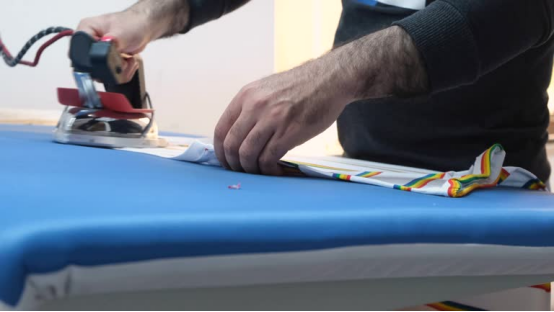
Precise angle adjustment: the key to making clothing structure more three-dimensional
When professional tailors shape garments, angle is even more important than temperature.
Allowing the ironing board to be freely adjustable ensures that each pressing motion is ergonomic and conforms to the natural drape of the fabric.
1. The sleeve cap needs to be raised.
The more defined the sleeve cap, the better the fit. If the pattern isn’t high enough, the sleeve cap will always look unnaturally stretched.
2. The skirt needs to be spread out at a low angle.
To allow the curve to unfold naturally, many tailors adjust the board to a near-horizontal angle.
3. Three-dimensional cutting requires mid-section support.
Some custom sewing boards are wider in the center and have more precise angle adjustments to accommodate actions such as pleating and stitching.
It is often mentioned on professional tailoring forums that precise angles can turn “ordinary pressing” into “garment structural shaping,” which is not an exaggeration, because the angle determines the direction of force on the fabric, and the direction of force determines the final line.
Professional ironing boards are the “hidden driving force” for tailoring efficiency.
The tailoring industry is never short of experienced tailors or craftsmen with unwavering dedication. What is truly scarce are the “silent tools” that allow their skills to be fully utilized.
Custom-made ironing boards are not about adding a sense of ceremony, but about maximizing professional capabilities, ensuring that every piece of fabric and every stitch is presented in its most ideal state.
If you’re also creating a more professional workspace, take a look at our curated selection of ironing Boards ; they might give you some inspiration.
What truly makes the process more efficient isn’t an expensive appearance, but the sense of control that comes with each heat press.
Would you be willing to upgrade your workspace to a state that’s more “suitable for your feel”? That might just be your next step.