
In the world of ironing, the real danger isn’t burns but something you almost never notice—the wobbling ironing board. A seemingly slight tilt can cause scalding steam to slide onto your arm or ruin an entire shirt in an instant. Thus, the often-overlooked detail of the non-slip feet becomes the most crucial invisible shield for ironing board safety.
“slipperyness.”This article will systematically analyze how anti-slip mats change the safety performance of ironing boards from three dimensions: stability, weight distribution, and durability. It will also combine industry trends and user experience to reveal the safety logic between “stability” and “slipperyness”.
Stability: The underlying logic that determines the security of the Ironing Board
collapse butIn real-world use, most ironing board tipping accidents are not due to structural collapse, but rather to slipping. According to a home safety assessment report published by Ideal Home, a stable ironing board typically possesses two characteristics: “anti-slip pads” and a “structural locking mechanism.” This means that the coefficient of friction between the bottom and the ground determines the safety level of the entire ironing system.
1. The Physical Principle of Anti-Slip Mats:
Anti-slip mats increase friction with the ground, counteracting horizontal displacement caused by hand pressure and steam vibration. Especially on low-friction surfaces such as tile and wood flooring, the grip of the mats determines whether the ironing board can remain stable.
2. Differences in structure and materials
- Rubber Base: It has high friction and is suitable for hard surfaces; however, it is prone to aging after long-term use.
- :Silicone Pad : Highly flexible, not easy to slip, and adaptable to different floor textures.
- :Plastic feet : lightweight but with poor grip, mostly used in low-cost models.
On a DIY forum, a user mentioned, “The ironing board is advertised as having non-slip feet, but it still slips slightly on tiles.” This shows that the material and design angle of the anti-slip mat are equally important—if the bottom angle does not fully conform to the ground, the anti-slip performance will be greatly reduced.
Weight distribution: a balance between safety and comfort
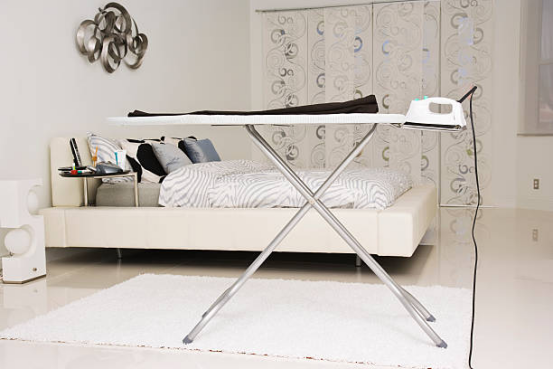
One often overlooked fact is that the safety of an ironing board depends not only on foot slip resistance but also on how weight is distributed. The anti-slip mat acts as a “load distributor” in this process.
1. The Scientific Logic of Pressure Distribution
: When you iron a heavy fabric, the pressure is transmitted to each support point through the ironing board. If the anti-slip pad material is too hard, it may “float” on the ground, causing wobbling; if it is too soft, it may sink in some areas, shifting the center of gravity. Ideally, the pad should have moderate elasticity and a high coefficient of friction to distribute pressure evenly across each foot.
2. Performance differences across different user scenarios
- Lightweight Ironing Board (Aluminum Frame): To prevent “lightweight” slippage, it is recommended to use it with absorbent feet.
- Heavy-duty Ironing Board (Steel Frame): Focuses more on shock absorption and protection against ground scratches.
- Foldable Board: Due to frequent movement, the foot pads need to balance grip and wear resistance.
A user on the Reddit Sewing community commented, “Zero wobble—that’s the best feature I didn’t expect.” This perfectly reflects the potential value of high-quality anti-slip mats in everyday life: a sense of security often comes from the quiet presence of details.
Durability: The Time Dimension of Safety Performance
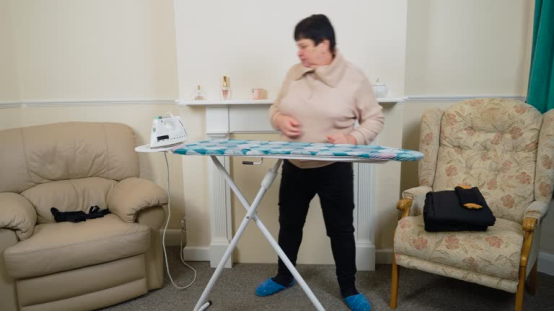
Even the best ironing board will suffer a significant drop in stability if the feet wear out, deform, or fall off. Durability is the foundation of safety, and the feet are precisely the most easily overlooked point of wear and tear.
1. Common signs of aging
- The rubber surface hardens, and cracks appear.
- Dust and oil buildup on the bottom reduces friction.
- The foot pads and support are loose, causing a slight wobbling.
2. Tips for extending lifespan
- Clean the surface of the floor mats regularly, using warm water and a neutral detergent to remove dust and grease.
- If the feet are severely worn, you can replace them with silicone parts of the same specification yourself.
- When used in high-humidity environments (such as laundry rooms), a moisture-proof and non-slip mat can be placed under the ironing board to prevent slipping and corrosion.
A home improvement review from The Spruce indicates that the Ironing Board, with its high-quality non-slip feet, maintains a 92% stability rate over a five-year lifespan, far exceeding that of ordinary plastic feet. This demonstrates that a small design detail can significantly impact the durability of safety.
The Transformation from “Portability” to “Safety Design”
In the past, consumers focused primarily on size and ease of folding when choosing an ironing board; now, safety is becoming a new competitive focus. More and more brands are incorporating anti-slip feet, center of gravity locking, and floor compatibility into their core selling points.
For example, many of the highly rated models on Ideal Home’s list share the common feature that “all four feet are non-slip and felt safe throughout use.” This is not just marketing rhetoric but a signal that consumer demand is shifting towards a safer experience.
Future trends will focus on:
- Multi-Surface Compatibility: Adaptable to tile, wood flooring, and carpet;
- Replaceable Pad System: Users can upgrade the anti-slip components themselves.
- Smart Grip Sensor: Monitors the ground friction coefficient and automatically adjusts the support angle.
This “security revolution starting from the ground” is redefining the functional boundaries of the Ironing Board.
Let safety be under your feet
The anti-slip pads on the ironing board, though small, determine the safety “center of gravity” of the entire platform. They are both physical fulcrums and psychological support—allowing users to concentrate and keep their hands steady while ironing.
If you’re considering upgrading your ironing board, pay attention to the details, especially the foot pads. A stable feel, precise friction, and reliable support are not just about comfort; they’re the first line of defense for home safety.
After all, true safety lies not on the surface but in the centimeter beneath your feet.