A Real Comparison of Ironing Boards and Stationary Mounts: Stability vs. Portability

How many times have you been about to iron a shirt when you heard a snap—your folding ironing board collapsed in half again? At that moment, you suddenly envied your friend’s wall-mounted ironing board: sturdy as a rock, and even the steam flows quietly through the clothes.
So the question arises—which is better? A portable ironing board or a fixed one? One is known for its flexibility, the other for its stability. Today, we’ll deconstruct this “light vs. heavy” debate in the world of housework.
Portable ironing board: A life-saving device that can be “appeared” at any time
For many, the most appealing aspect of an ironing board is its mobility. You can iron clothes while watching a show in the living room or straighten them out while enjoying the sunshine on the balcony. It can be folded up and moved around at any time, taking up very little space. For renters, small families, or those who prefer to avoid the burden of housework, this is undoubtedly a life-enhancing experience.
Modern portable ironing boards are becoming increasingly user-friendly. Many brands incorporate details like adjustable height, lightweight aluminum stands, and non-slip feet. Take IKEA’s JÄLL, for example. The entire board weighs less than 5 kilograms, yet it provides stable support for ironing. Higher-end models even come with cord storage and a thick, heat-resistant cover, making the ironing experience even more professional-grade.
However, portability does not mean perfection. Common feedback from long-term users:
- Slightly less stable: especially on uneven floors or carpeted areas, it tends to wobble;
- Limited durability: The folding bracket may become loose or rust after repeated opening and closing.
- The board surface is too small: when handling large items of clothing such as bed sheets and windbreakers, the operating space is limited.
In other words, it is a little helper that is always available, but it may not be able to meet the ironing needs of the whole family.
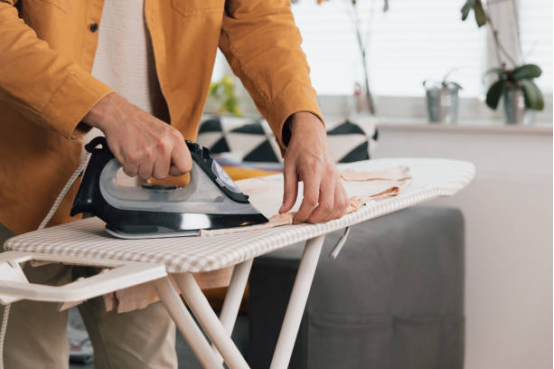
Fixed ironing table: a cornerstone of household chores that never leaves the job
A fixed ironing board (also called a built-in ironing station) embodies another lifestyle philosophy: stability, cleanliness, and efficiency. It’s often installed in laundry rooms, closets, or even inside wall cabinets. When unfolded, it becomes a complete ironing workstation; when folded, it blends seamlessly into the wall, taking up virtually no space.
This type of design was originally popular in Europe and North America and is now gradually entering Asian homes. Some brands (such as Häfele and Household Essentials) have launched built-in ironing boards with rotating hinges and fixed locks, which can adjust the angle according to the user’s height. The advantages are very obvious:
- Unmatched stability: Fixed mounting means virtually no shaking, allowing for balance even when pressing hard on thick fabrics;
- High efficiency: no need to open and close, or adjust every time; just open and start working.
- Visually neat space: For users who pursue home aesthetics, the fixed type is more like a part of the design.
However, the shortcomings of the fixed type are also obvious:
- High installation cost: Professionals are required to measure and fix the equipment;
- Inflexible: Once the installation location is determined, it cannot be moved;
- Not suitable for short-term rentals or temporary accommodation.
A user commented on Reddit’s home appliance forum: “I like the stability of the fixed board, but when I move, it becomes the biggest ‘burden.'” This sentence almost summarizes the fundamental contradiction between portability and fixation: one pursues freedom, the other pursues order.
Stability vs. Portability: How to Find Your “Sweet Spot”
In real life, few people pursue only one extreme. Most consumers are actually looking for a balance when choosing
an ironing board. Here are a few key dimensions to help you evaluate which one best suits your lifestyle:
1. Spatial structure
If your home has a separate laundry room or a fixed ironing area, a fixed one is a long-term investment.
If you live in an apartment and move frequently, a portable device is a more practical choice.
2. Frequency of use
Only iron your shirts once a week? Portable enough;
Do you need to handle multiple loads of laundry every day? A stationary-style laundry machine can significantly improve your efficiency.
3. Residential Style:
Fixed ironing boards easily integrate into minimalist or modern designs, even complementing wooden cabinets to create a visual highlight. Portable ironing boards, on the other hand, are ideal for functional spaces, such as multi-purpose living rooms or shared living spaces.
4. Cost and Maintenance:
Portable models have a wide price range, ranging from $30 to $150; fixed models typically start at over $200, plus installation fees. However, fixed models tend to be more durable in the long term, with an average lifespan of over 10 years.
Industry Trends: According to Statista’s 2024 Home Appliance Consumption Report, portable ironing boards will still dominate the market (approximately 72%), but stationary products are growing faster, particularly among high-income households, with a 15% increase. This suggests that consumers are beginning to consider the “ironing experience” as part of their home design.
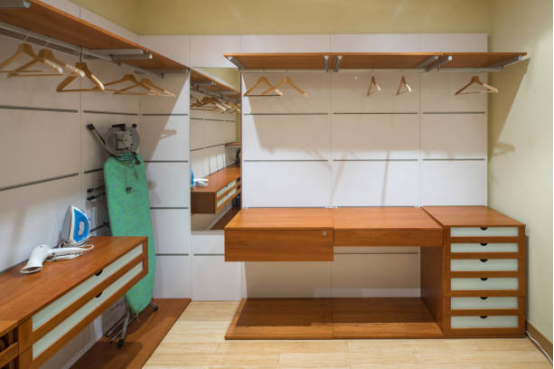
User experience record: real voice is more persuasive than advertising
During a user survey, we interviewed two types of people: a professional image consultant and a housewife.
The consultant said, “I prefer the fixed type. The stability allows me to focus on details like cuffs and lapels.”
The other user smiled and replied, “I use the foldable type. When the children are asleep, I can move the ironing board to the balcony without worrying about waking them.”
The two have completely different needs, but both have valid points. This also confirms the fact that ironing boards are never a standardized product but a lifestyle choice.
Light and heavy, mobile and stable
Each ironing board, in some sense, reflects your approach to life. Some people prefer flexibility, treating ironing as an occasional emergency measure; others seek a sense of ritual, wanting every piece of clothing to be as crisp as if it just came from the dry cleaner.
If you prefer efficiency and neatness, fixed type is an irreplaceable long-term investment.
If you value flexibility and freedom, portable type is your life partner.
Perhaps the ideal solution is to allow both solutions to coexist: a fixed model serving as the mainstay of the laundry area, with a lightweight foldable model ready for use at any time. This “dual system” design is being adopted by more and more modern families.
The next time you unfold that board, think about it—what you really need is not just a flat surface, but a smoother and more comfortable rhythm of life.